Moving to Zurich Checklist 2026: Your First 30 Days
The order that works
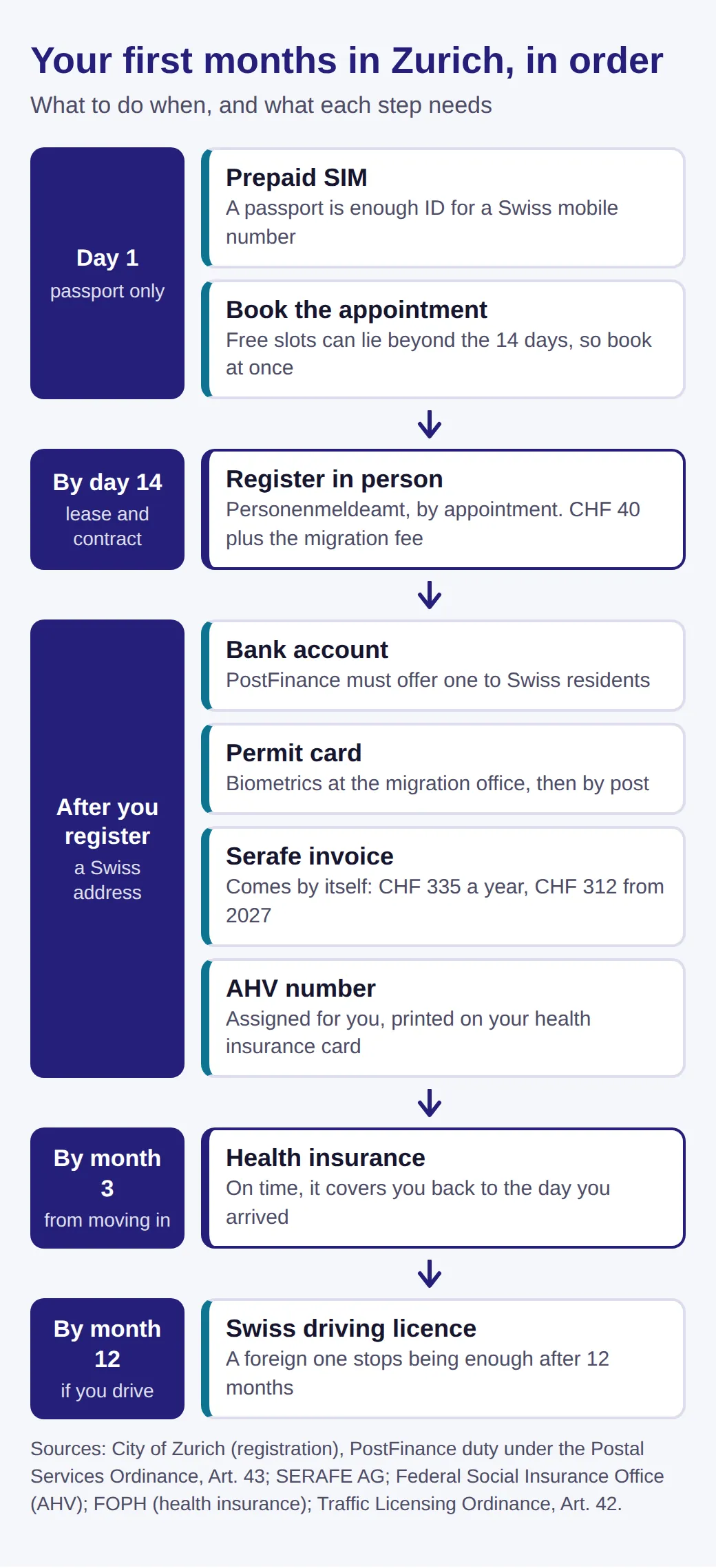
Book your registration appointment the day you arrive and register in person within 14 days of moving in. Get a prepaid SIM with your passport, open a bank account once you have a Swiss address, and take out health insurance within three months. Your AHV number and the Serafe radio and TV bill find you on their own.
Many checklists stop at "register with your commune". In the city of Zurich that step has a name, an address, a booking system and, in October 2026, a waiting list, and several of the later steps cannot start until it is done. So this is a list in order, with the official source for each step and the prices as they stand in October 2026, including the ones that change in December and January.
Your first months, in order
The order matters more than the speed. A SIM card needs only your passport, so it comes first. Registration needs a signed lease and your employment contract, and it unlocks almost everything else: your permit card, the right to a bank account, your entry in the household register that the radio and TV fee is billed from. Health insurance has the longest deadline, and missing it costs you a surcharge.
If your employer runs a relocation service, it will often handle some of this, but the deadlines are yours. Start with the step that has a queue.
Before you land: what to have in your bag
You need four things at your registration appointment besides yourself: a passport, a lease, your employment contract and, if you come from outside the EU and EFTA, the paper that says your permit has been approved.
That last part starts long before you fly. For a third-country national, the employer applies for the work permit to the canton's office for the economy, the federal migration office has to agree, and only then does the cantonal migration office tell the Swiss embassy to issue your visa, or give your employer a written assurance of the permit if you need no visa. The canton's page on work permits for non-EU nationals sets out these steps and the 2026 quotas: 8,500 permits for specialists from third countries, plus a separate 3,500 for UK citizens. Bring that assurance (Zusicherung der Aufenthaltsbewilligung) or the visa authorisation to the appointment, as the city's list asks.
The lease is the other early document. The city accepts a lease, a sublease or a confirmation of your housing, and it can also accept a move-in notice (Einzugsanzeige). Whoever houses you, landlord, main tenant or host, has to report your move-in to the city themselves within 14 days, which is useful to know if you start in a sublet or a friend's spare room.
With those papers ready, the first day is short.
Day one: a Swiss number with just your passport
A prepaid SIM is the one thing you can sort out on day one, because Swiss law asks for nothing more than an identity document.
Federal rules require the mobile provider to check your identity when it hands over the SIM or activates the service, and they list what counts: a Swiss or foreign passport, a Swiss or foreign identity card, or a Swiss foreigner's permit. Your passport is enough. The provider also records your address, so give the one you are moving into.
It is easier to give the same Swiss number everywhere from the start, to your employer, your landlord and the offices below. The same evening, book your registration appointment, because that is where the waiting starts.
Where do you register in Zurich, and how fast?
At the Personenmeldeamt, within 14 days of moving in, in person and by appointment only. If you have read about the Kreisbüro, that office no longer exists.
The city merged its twelve district offices into three on 12 June 2023 and said at the time that "Die Bezeichnung «Kreisbüro» wird künftig nicht mehr gebraucht": the name Kreisbüro would no longer be used. Older guides still send you to a Kreisbüro, and walking in is no longer an option. The city's page for arrivals from abroad says you must register within 14 days, that you need an appointment, that arrivals from abroad register in person at the Personenmeldeamt Zürich Süd, and that you can only register once you have actually moved in. A family registers together, and everyone has to come.
The catch is the queue. In October 2026 the city's page warned that some of the free appointments fall after the 14-day deadline. Its advice: book the next free slot anyway, ask for an extension through its contact form, and use the "reschedule" link in your confirmation email to check for earlier slots that open up.
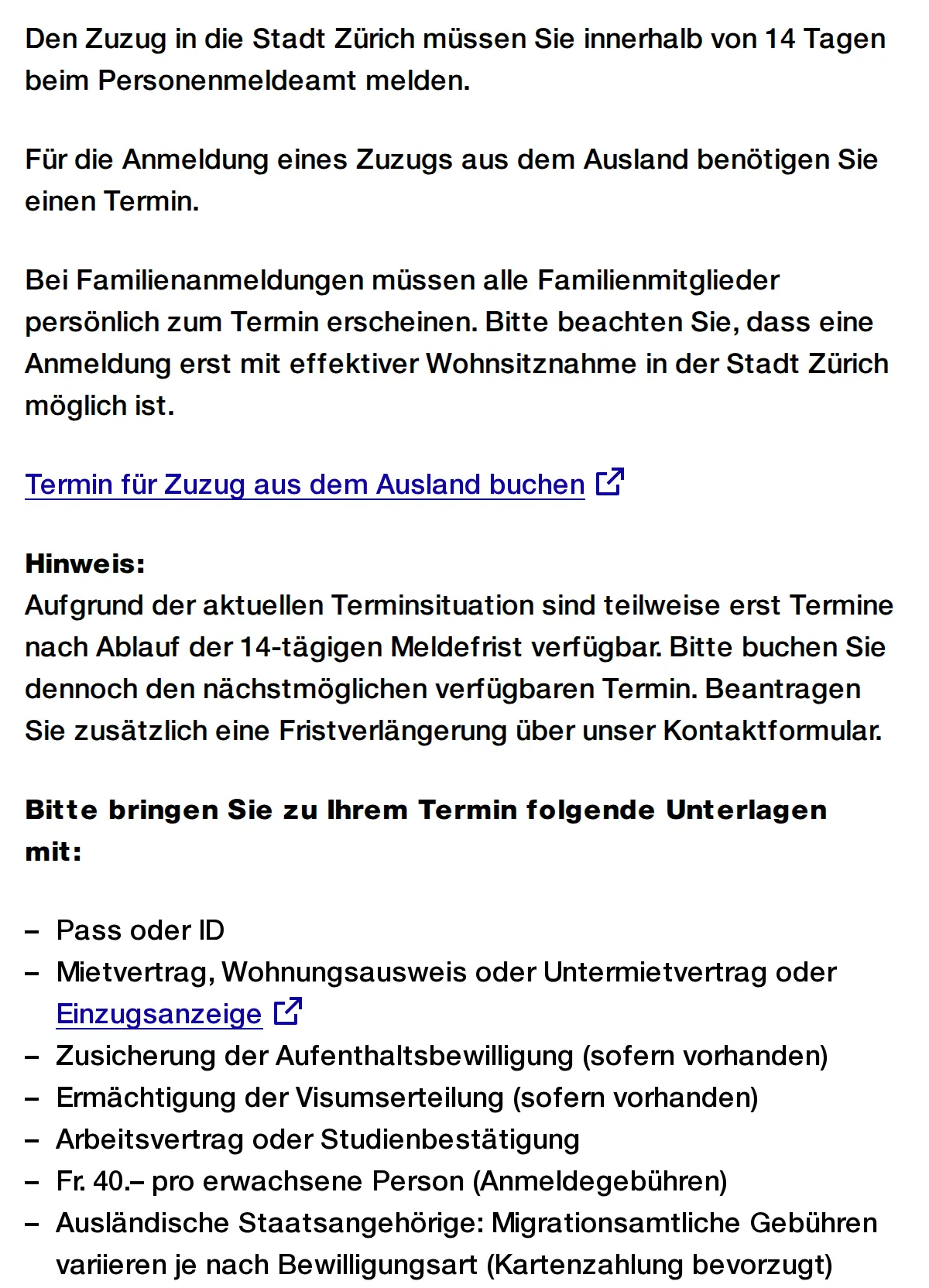
Here is what to bring, from that list: your passport or ID card, the lease or move-in notice, the permit assurance or visa authorisation if you have one, and your employment contract. Married couples moving together bring the original marriage certificate, and parents the children's original birth certificates. Civil status documents that are not in a Swiss national language or in English need the original plus an official translation. You pay CHF 40 per adult to register, plus the migration office's fee for your permit, which the city puts at CHF 72 to 127 per adult for EU and EFTA citizens and CHF 124 to 144 for other nationals. The city prefers card payment for the migration fee.
If you need the western branch later, note that from 2 November 2026 Personenmeldeamt West is at Hardstrasse 41. Registration is the gate. The permit card comes out of it.
Which permit you get, and when the card comes
The kind of permit depends on your passport and your contract. For an EU or EFTA citizen, an open-ended contract or one for at least 365 days brings a B permit valid for five years. A contract between three months and a year brings an L permit that runs as long as the contract. Work of less than three months in a calendar year needs no permit at all, only an online notice.
For other nationals the type was settled before you came. What remains is the card. The canton's page says you have to go to the migration office in person so it can take your biometric data, after which the card is produced and posted to you. Federal rules say that if you came on an entry permit for more than four months of work, you can start working once you have registered, unless the authority decides otherwise. That is one more reason not to let the appointment slide past your first day at work.
The canton does not publish a processing time, so keep the permit assurance and your registration receipt together until the card arrives. Next comes the deadline that most guides mention but few explain.
How long do you have to get health insurance?
Three months from the day you take up residence. If you sign up within that time, the cover starts on the day you moved here and pays for any doctor's bills since then. You also pay premiums back to that day.
That is the rule the Federal Office of Public Health spells out on its page on compulsory health insurance. If you join late, the cover starts only on the day you join, and you pay a surcharge unless the delay was justified. If you do nothing at all, the canton signs you up with an insurer of its choosing. So the three months are not a grace period to save money: the premiums are owed either way. They are only time to compare.
Two details matter for someone on a full-time contract. First, your employer already insures you against accidents. Suva, the public accident insurer, says employees are covered for accidents at work and, if they work more than eight hours a week, for accidents in their free time too. The health office says your health insurer will remove accident cover if you ask and show that you are fully covered through your job, and lower your premium accordingly. Second, premiums change every January, and you can switch insurer for the new year until the end of November, as the office's release on the 2027 premiums reminds. If you arrive in October or November, choose with next year's price in mind.
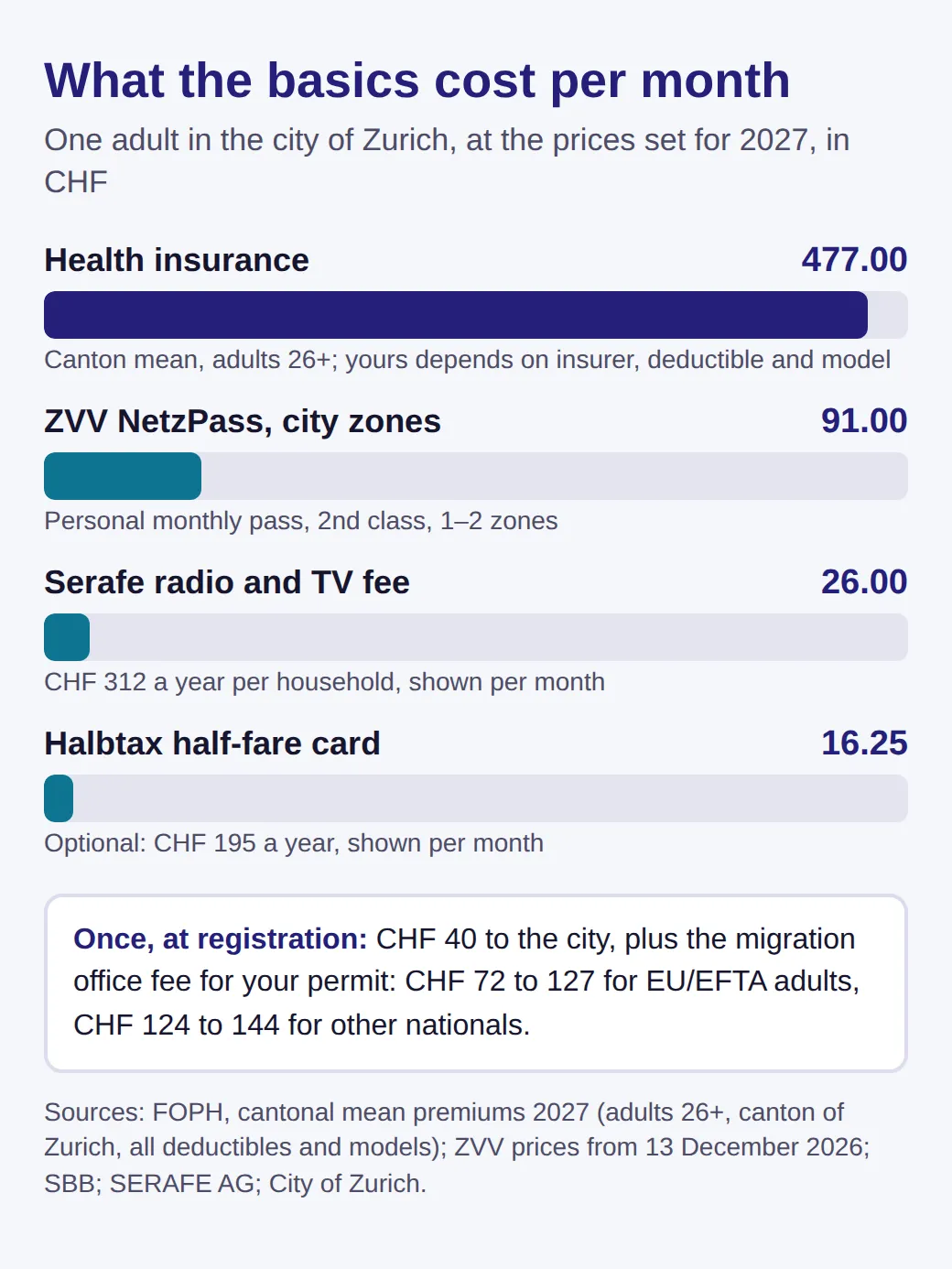
That price is the biggest fixed cost on this list by far. In the canton of Zurich, the mean premium for adults aged 26 and over is CHF 451.30 a month in 2026 and CHF 477.00 in 2027, according to the federal table of cantonal premiums. For 19 to 25-year-olds it is CHF 333.80 in 2027. The mean covers every deductible and model, so your own premium can be well above or below it.
With registration done and insurance chosen, money is the next thing to sort.
Why the bank account comes after registration
Because the one bank that has to take you is required to do so only once you live in Switzerland.
Switzerland has no general right to a bank account, but it does have a universal service rule for payments. The federal postal ordinance requires PostFinance to offer at least one payment account to people with their residence in Switzerland, with transfers, cash deposits and withdrawals in Swiss francs. It may refuse a customer only on narrow grounds, such as anti-money-laundering rules. Other banks decide for themselves whom they accept.
In practice that means two things. Ask your employer whether your first salary can wait for a Swiss account or go to a foreign one, and open the account as soon as you have registered rather than before. Keep your registration confirmation and your permit papers handy, because the bank will check your identity and where you live.
The salary itself brings two more numbers you never have to apply for.
Do you need to apply for an AHV number?
No. The AHV number, your Swiss social security number, is assigned automatically when you settle in Switzerland, says the Federal Social Insurance Office. If you still lack one when you start, your employer reports you to a compensation fund, which requests it.
You will find it on your health insurance card: 13 digits, starting with 756. A separate AHV card is not needed and is not issued automatically. Knowing the number is enough for dealing with the authorities and your employer.
Tax works much the same way at first. If you are a foreign national without a C permit, and not married to a Swiss citizen or a C permit holder, your employer deducts income tax from your salary and pays it to the tax office before you are paid. Nothing to file in your first month. The next bill, though, arrives whether you expected it or not.
Serafe: the bill you never signed up for
Serafe is the company that collects Switzerland's radio and TV fee, and it bills every private household the same amount.
You don't register with it. The law says the household as recorded in the residents' register is what counts, and the fee starts on the first day of the month after the household is formed. So your registration at the Personenmeldeamt is what puts you on Serafe's list. Serafe's site gives the fee as CHF 335 a year for a private household, falling to CHF 312 from 1 January 2027. The invoice comes once a year unless you ask for quarterly billing, and every adult in the household is named on it and jointly liable. If the names or address are wrong, Serafe tells you to correct them with the residents' office, not with Serafe.
Serafe also warns about phishing in its name: it does not send emails with links asking for account details, and it does not ask for payment by TWINT. Treat any such message as fake.
That leaves the pass you will use every day.
Which public transport pass to buy
For the city of Zurich, a personal ZVV NetzPass for 1 to 2 zones, and if you travel around Switzerland at weekends, a Halbtax as well.
The city is zone 110, and the ZVV says that for the city of Zurich you need a pass for 1 to 2 zones. For an adult in second class it costs CHF 88 a month or CHF 813 a year until 12 December 2026. From 13 December, the new ZVV prices are CHF 91 a month and CHF 840 a year. If you commute from outside the city, count your zones on the ZVV map first. A personal pass is loaded onto the SwissPass card, and the ZVV says a monthly pass already pays off at three to four trips a week.
The Halbtax, the half-fare card, halves most train fares across the country. The SBB lists it for adults aged 25 and over at CHF 190 a year, rising to CHF 195 from 13 December 2026.
What can wait until after day 30
Some things have longer deadlines but still need a date in your calendar.
Your foreign driving licence works for a while, but under federal rules you need a Swiss licence once you have lived here for twelve months. Your health insurance choice can be revisited each November. And when you move to another municipality, the same 14-day rule applies: you register at the new one and deregister at the old one within that time.
German is the working language of this paperwork: the city's arrival page is only in German, and so are the permit pages and laws linked here. That is a different question from whether you need German at your desk. We look at that in German at work in Zurich.
What to do once you have signed
If you have signed with a Zurich employer and have a start date, plan three things. Book the registration appointment on the day you move in and take the first free slot, asking for an extension if it falls after the 14 days. Put the date three months after your move in your calendar as the health insurance deadline, and compare insurers before it with accident cover left out. And check with HR whether your first salary can wait for a Swiss account.
If you are still choosing where to work, our overview of who hires software engineers in Zurich shows which employers had the most open roles. Once the paperwork is behind you, the city's tech meetups are a good way to meet the people you will work alongside.
Common questions
- What if I live outside the city of Zurich, in Winterthur or Uster?
- Then you register with the residents' office of your own municipality, not with the city's Personenmeldeamt. The permit steps run through the canton's migration office as in the city, but each municipality sets its own fees and booking rules. Check its website for the documents it wants and whether it works by appointment.
- I already have health insurance from my home country. Do I still need Swiss cover?
- As a rule, yes: living in Switzerland makes basic Swiss health insurance compulsory. Some people can be exempted, and the cantonal authority where you live or work decides on each request. Ask for the exemption before your three months are up, so you still have time to join a Swiss insurer if the answer is no.
- Do flatmates each pay the Serafe fee?
- No. The fee is charged once per household, whatever the number of people in it. Every adult in the household is named on the invoice and is jointly liable for paying it, so agree early on who pays and how you split it.
- Can I keep driving on my foreign licence?
- For a while. Once you have lived in Switzerland for twelve months, the federal rules require a Swiss licence, so plan the exchange with the cantonal road traffic office well before then. Until that point, your valid national licence is enough if it shows the vehicle categories clearly and in Latin script; if it does not, carry an international licence with it.
More posts
All posts
Software Engineering Internships in Zurich for Summer 2027
Who takes software engineering interns in Zurich for summer 2027, when to apply, what it pays, and the 15-hour and compulsory-internship permit rules.

Cheapest Health Insurance in Zurich for 2027, Ranked
The lowest 2027 basic health insurance premiums in Zurich, city and region 2, by model, from federal data. Plus the deductible maths and the 30 November rule.

80 Percent Jobs in Zurich: The Four-Day Week in Tech, 2026
How many Zurich software ads allow 80%? We read 287 listings in October 2026. How to ask for four days, and what it does to pay, pension and holidays.