Cheapest Health Insurance in Zurich for 2027, Ranked

The cheapest for 2027
For 2027, the cheapest basic health insurance in the city of Zurich, for an adult with a CHF 2,500 deductible and no accident cover, is Sanitas's TelMed Basic at CHF 384.05 a month. With free choice of doctor, Sumiswalder is cheapest at CHF 471.10. In region 2, which takes in Winterthur, Uster and most lake towns, Assura's MediTel costs CHF 342.50.
Those figures come from the premium file the Federal Office of Public Health (BAG) publishes as open data: every premium that every insurer filed for 2027, in every canton, region, model and deductible. We took the 27 insurers active in the canton of Zurich, kept the adult rows (age 26 and over) at the CHF 2,500 deductible, and ranked the lowest price each insurer offers in each model. We left out accident cover, because you don't need it in your health insurance if you work at least eight hours a week for one employer. More on that below.
Which Zurich premium region are you in?
Region 1 is the city of Zurich alone. Region 2 is 37 municipalities, mostly around the city and the lake plus Winterthur, and region 3 is the other 121.
The regions are set by the federal ordinance on premium regions, whose annex lists every municipality. Region 2 includes Winterthur, Uster, Dübendorf, Kloten, Opfikon, Wallisellen, Schlieren, Dietikon, Regensdorf, Adliswil, Thalwil, Horgen, Wädenswil, Küsnacht, Zollikon, Meilen and Stäfa. The same ordinance caps the gap for the standard premium: in Zurich, region 2 may be at most 15% cheaper than region 1, and region 3 at most 10% cheaper than region 2.
What counts is where you live, not where you work. For the cheapest standard premium the gap is CHF 68 a month: 471.10 in the city against 403.10 in region 2. That's CHF 816 a year for the same cover, a number worth knowing if you are still choosing between a flat in Kreis 4 and one in Dübendorf.
For context, the BAG's table of cantonal averages puts the mean 2027 premium for adults in the canton at CHF 477.00 a month, up 5.7% on 2026. That mean mixes every deductible and model people actually hold, so it sits well above the cheapest offers below.
The cheapest standard model in Zurich
The standard model lets you see any doctor you like, and it is the most expensive way to buy the same cover. These are the five lowest 2027 premiums, in CHF a month:
| Rank | City of Zurich (region 1) | Region 2 |
|---|---|---|
| 1 | Sumiswalder, 471.10 | Krankenkasse Wädenswil, 403.10 |
| 2 | SLKK, 474.40 | SLKK, 406.00 |
| 3 | Sanitas, 479.95 | Sumiswalder, 418.50 |
| 4 | EGK, 488.40 | ÖKK, 420.10 |
| 5 | Krankenkasse Wädenswil, 489.70 | rhenusana, 422.00 |
The top of this list belongs to small insurers. Sumiswalder, a small fund based in Sumiswald, insured on average 1,448 people in the canton of Zurich in 2025, according to the BAG's count of insured persons; Helsana, the largest, insured more than 300,000. For basic cover, size changes nothing about what you get. Every insurer must accept you whatever your age or health, without a questionnaire, and pays for the same treatments.
The spread is wide. The dearest standard premium in the city is Galenos at CHF 581.70, CHF 110.60 a month above Sumiswalder for identical cover.
One detail changes the order. If you keep accident cover in your policy, SLKK moves to first place in the city at CHF 504.70 and Sumiswalder drops to second at 506.50. The accident share is priced differently at each insurer, so rank the version you will actually buy. The bigger saving, though, comes from giving up free choice of doctor.
Family doctor models: the doctor you pick sets the price
In a family doctor model, a practice you name in advance is your first stop and refers you on when needed. In the city it takes CHF 69 a month off the cheapest standard premium.
| Rank | City of Zurich (region 1) | Region 2 |
|---|---|---|
| 1 | Sanitas Hausarztmodell 1, 402.00 | Sanitas Hausarztmodell 1, 358.55 |
| 2 | Helsana BeneFit PLUS R1, 402.50 | Helsana BeneFit PLUS R1, 359.30 |
| 3 | CSS Gesundheitspraxis, 411.50 | KPTwin.doc, 362.20 |
| 4 | KPTwin.doc, 413.40 | SLKK HomeCare, 363.00 |
| 5 | Assura family doctor, 414.70 | Assura family doctor, 364.20 |
Read the top two rows carefully. Helsana sorts practices into discount levels R1 to R4, and its page on the model says the level of the practice you choose affects your premium. R1 carries the biggest discount, and R4 practices have no contract with Helsana. So CHF 402.50 is only your price if your doctor is an R1 practice. Sanitas files four family doctor tariffs, numbered 1 to 4, and only tariff 1 tops the list. Before you sign, ask which tariff your doctor falls under.
A note on method. For 2027 the BAG merged family doctor and HMO plans into one category called PRAXIS. We split them again using the categories the BAG itself gave each plan for 2026, which is why CSS's Gesundheitspraxis plan, filed as a family doctor model then, appears here.
HMO plans: Atupri leads in both regions
In an HMO, your first stop is a group practice or a network of doctors that works with the insurer. Atupri's HMO is the cheapest in both regions.
| Rank | City of Zurich (region 1) | Region 2 |
|---|---|---|
| 1 | Atupri HMO, 386.50 | Atupri HMO, 349.00 |
| 2 | Vivao Sympany casamed hmo, 398.60 | KPTwin.plus, 353.60 |
| 3 | KPTwin.plus, 403.40 | Concordia HMO, 355.70 |
| 4 | Concordia HMO, 405.70 | Visana Managed Care, 360.00 |
| 5 | SWICA Favorit Santé, 423.00 | ÖKK Casamed HMO, 368.50 |
Only 13 insurers offer an HMO plan in Zurich, against 25 with a family doctor plan, and the price only helps if one of the plan's practices suits you. The practical test is distance: pick the plan, open the insurer's list of practices, and check there is one you can reach on a weekday lunch break. If you'd rather not go to a practice at all, the next group is cheaper still.
Telmed and app models: the lowest premiums in Zurich
Telmed models make a phone call, video call or app your first contact, and they give the lowest premiums of all. The BAG calls this category TEL_DIG.
| Rank | City of Zurich (region 1) | Region 2 |
|---|---|---|
| 1 | Sanitas TelMed Basic, 384.05 | Assura MediTel, 342.50 |
| 2 | Avenir SanaTel, 394.70 | KPTwin.smart, 345.00 |
| 3 | KPTwin.smart, 398.50 | SLKK SmartMed, 352.60 |
| 4 | Assura MediTel, 399.50 | Sanitas TelMed Basic, 353.10 |
| 5 | Atupri SmartCare, 411.80 | Concordia smartDoc, 366.80 |
KPTwin.smart combines a family doctor with an app, but the BAG files it here. Sanitas's TelMed Basic in the city is CHF 87.05 a month below the cheapest standard premium, or CHF 1,044.60 a year. A fifth group, which the BAG calls FLEX, lets you choose between several first contacts: Assura's QualiMed comes within 15 centimes of the cheapest city premium at CHF 384.20.
Every one of these models has rules, and breaking them costs you. Helsana, for example, says it can move you into its standard model if you see a specialist without a referral, and the discount goes with it. If you would call a hotline before seeing a doctor anyway, the telmed rule costs you little. If you already have a family doctor you trust, a family doctor plan with that practice is the safer choice.
The cheapest for 2026 are not the cheapest for 2027
The ranking shifts every autumn, so a choice that was right for one year can be expensive the next. We ranked the 2026 premiums the same way and followed the six cheapest standard plans in the city into 2027.
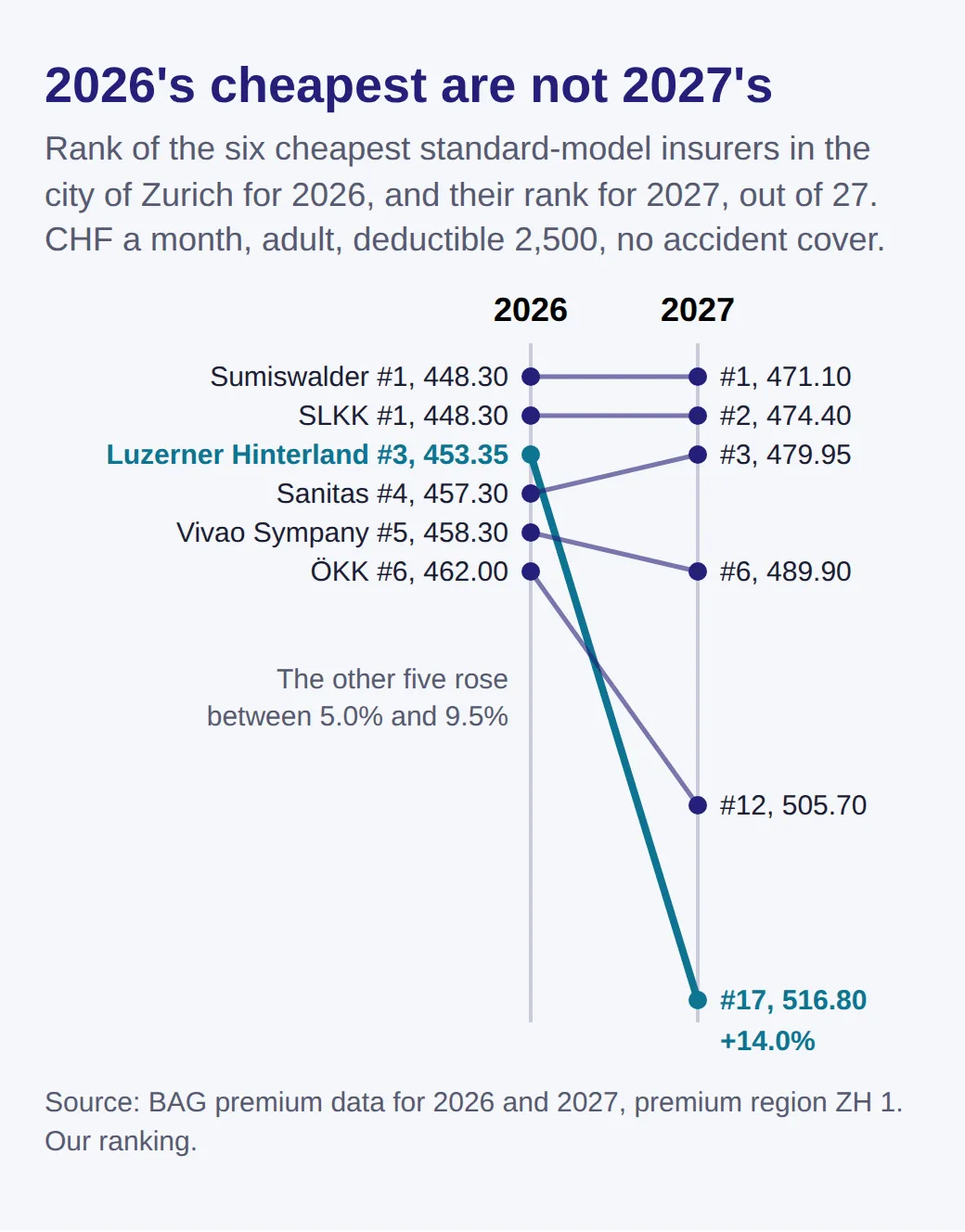
Krankenkasse Luzerner Hinterland was the third cheapest standard plan in the city for 2026 at CHF 453.35. For 2027 it costs CHF 516.80, up 14.0%, and ranks 17th of 27. The other five rose between 5.0% and 9.5%. Insurers must tell you their new premium by 31 October, so the letter is your cue to rerun the comparison.
The other choice that matters as much as the insurer is the deductible.
Is the CHF 2,500 deductible worth it in Zurich?
For a healthy engineer who rarely sees a doctor, yes: on Sanitas TelMed Basic in the city, the CHF 2,500 deductible beats the CHF 300 one until your bills pass about CHF 1,893 in a year.
The rules behind that number are short. Under the health insurance act, you pay the deductible first, then 10% of the bills above it. The ordinance caps that 10% at CHF 700 a year for adults. So the most you can pay out of pocket in a year is CHF 1,000 with the CHF 300 deductible and CHF 3,200 with CHF 2,500.
Now the prices. Sanitas TelMed Basic costs CHF 503.50 a month with the CHF 300 deductible and CHF 384.05 with CHF 2,500, a difference of CHF 1,433.40 a year. Up to CHF 300 of bills, both cost you the same in treatment. Above that, the high deductible makes you pay 90 centimes more per franc of bills, until the premium saving is used up at about CHF 1,893.
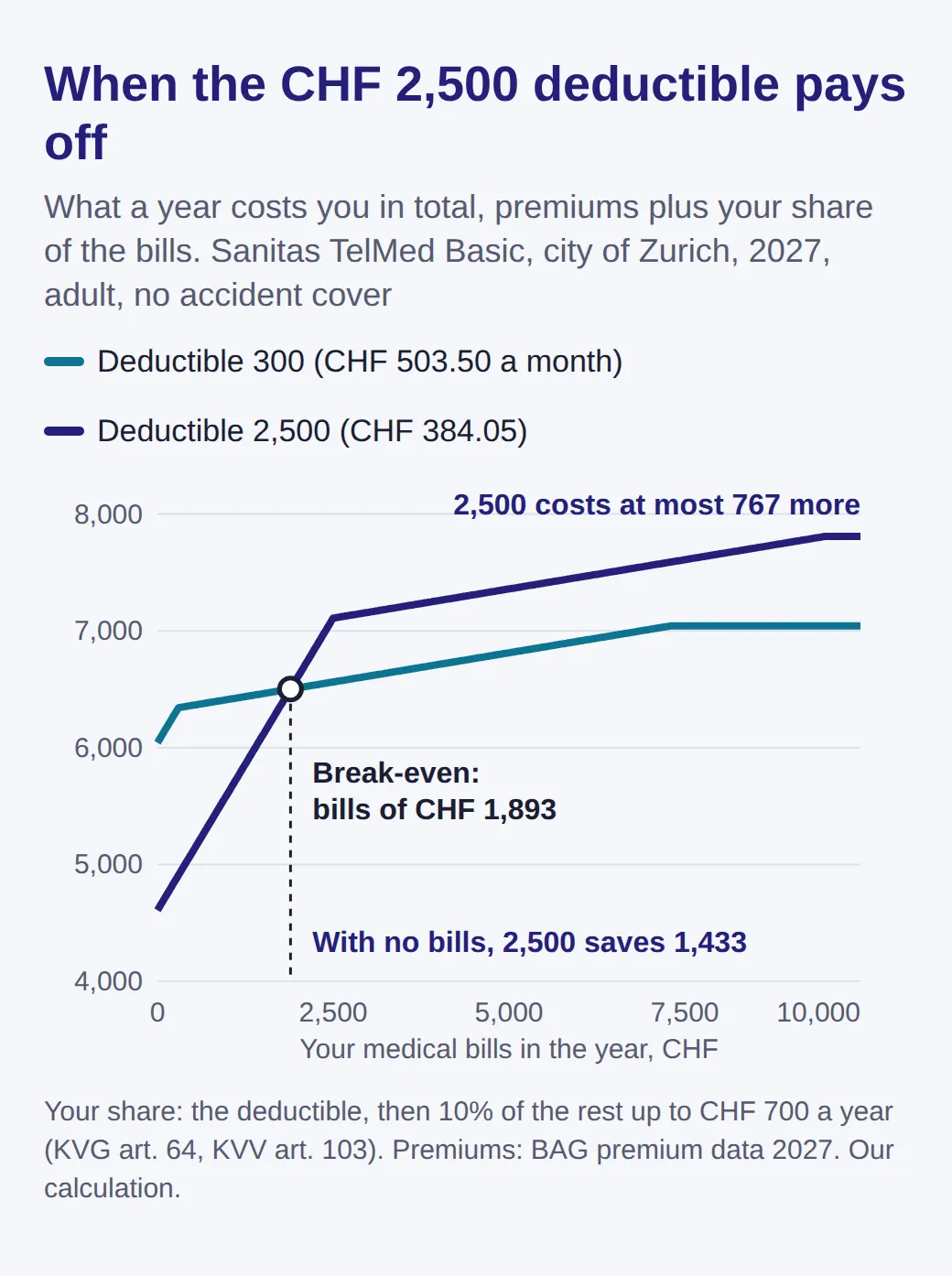
The downside has a ceiling. Above about CHF 9,500 of bills, both deductibles hit their maximum, and the CHF 2,500 one leaves you CHF 766.60 worse off for the year. The deductibles in between never came out cheapest for this plan at any level of bills. That follows from the law: the ordinance limits the discount to 70% of the extra risk you take on, which the BAG's savings page translates into at most CHF 1,540 a year off for the CHF 2,500 deductible.
So the rule is simple. If you expect bills well under CHF 1,900 and you can keep CHF 3,200 aside for a bad year, take CHF 2,500. If you have a chronic condition, regular therapy or a planned operation, take CHF 300. Timing matters too: under the ordinance, a higher deductible can start only on 1 January, and a lower one only at the end of a year, with the same notice as a change of insurer.
What a switch is worth: one worked example
Put model, deductible and accident cover together, and the gap gets large. Helsana is the largest insurer in the canton. Its standard plan with the CHF 300 deductible and accident cover costs CHF 676.00 a month in the city for 2027, or CHF 8,112 a year.
Sanitas TelMed Basic with CHF 2,500 and no accident cover costs CHF 4,608.60 a year. That's CHF 3,503.40 less in premiums. In the worst year, with both out-of-pocket maximums reached, you would pay CHF 9,112 on the first plan and CHF 7,808.60 on the second, still CHF 1,303.40 ahead.
Dropping accident cover is only safe if your employer covers you. The BAG's savings page says that if you work at least eight hours a week, your employer must insure you against accidents at and outside work, and your insurer will remove the cover once you send it your employer's confirmation. The act puts it back automatically when that cover ends. If you are about to drop to part time, our post on 80% contracts covers where that line sits.
How to switch by 30 November
Your cancellation has to reach your current insurer by 30 November for a switch on 1 January 2027. The rule is in the health insurance act: when your insurer announces a new premium, you can leave with one month's notice to the end of the month before it applies. Receipt counts, not the postmark.
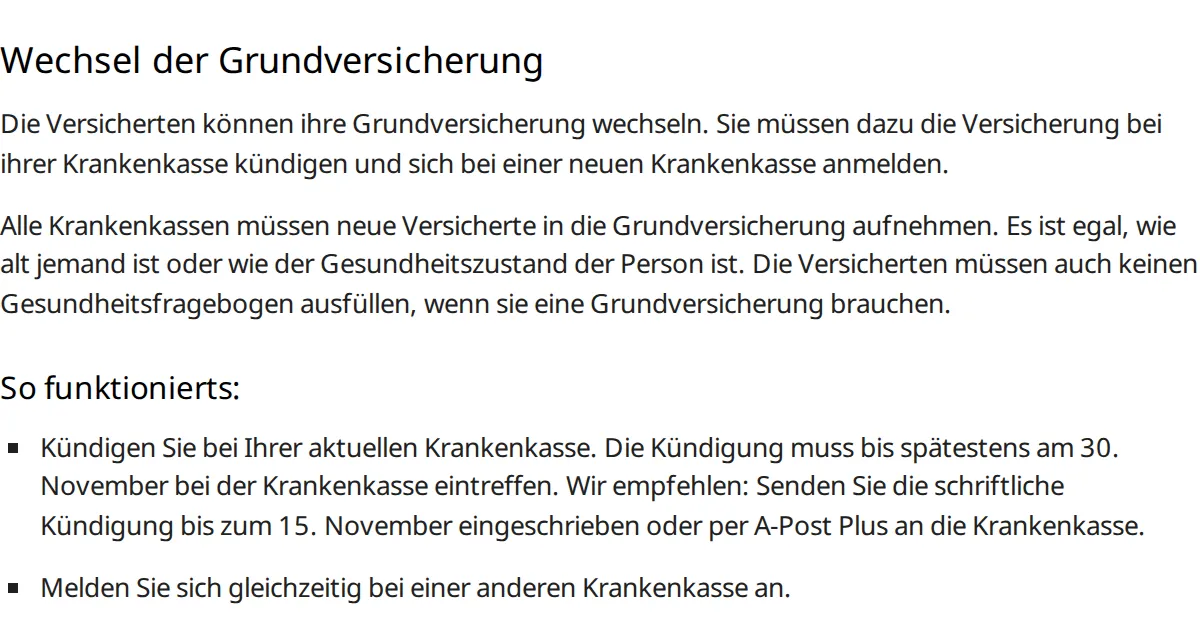
The BAG suggests sending the letter by 15 November, registered or by A-Post Plus, and signing up with the new insurer at the same time. Under the same article, your old cover ends only once the new insurer has told the old one that you are insured without a gap, so you are never left without cover. One thing blocks a switch: overdue premiums or bills at your current insurer. Pay those first.
Staying with your insurer but moving to a cheaper model is easier. The ordinance lets you move from the standard model into a model with restricted choice of doctor at any time; only a move the other way waits for the end of the year. If you have only just arrived, our first 30 days checklist explains the three months you have to take out cover at all.
Supplementary insurance runs on its own terms
Supplementary insurance is a separate private contract, and nothing above applies to it. Its notice period is whatever your policy says, and the insurer can ask about your health before it accepts you.
The two can sit with different insurers. The act says your old insurer may not force you to cancel your supplementary cover when you move your basic insurance, and may not cancel it just because you left. So you can take the cheapest basic plan and keep a hospital or dental policy where it is. The BAG's page on supplementary insurance adds a warning: once cancelled, a supplementary policy cannot always be taken out again, especially past a certain age, which the BAG puts at 55 to 65, or in poor health. Never cancel one before a new one is confirmed in writing.
What to do before 30 November
Start with your address: city, region 2 or region 3. Then decide which first contact you can live with, a hotline, an app, a named family doctor or a group practice, and price that model on the BAG's premium calculator, which runs in German, French and Italian. If you pick a family doctor plan, ask the insurer which tariff your doctor falls under. Choose the deductible from last year's bills, not from hope. Remove accident cover if you work eight hours a week or more. Then post the cancellation, registered, by mid-November, and keep the receipt.
Common questions
- Does a cheaper insurer pay for less?
- No. Basic insurance covers the same treatments at every insurer, and the treatments cost the same wherever you are insured. What differs is the premium, the service, and the rules of the model you pick, such as calling a telemedicine line first.
- Can a Zurich insurer turn me down because of my health?
- Not for basic insurance. Every insurer must accept you in the cantons where it operates, whatever your age or health, and you don't fill in a health questionnaire. Supplementary insurance is different: there the insurer can ask about your health and refuse you.
- I live in Winterthur but work in the city. Which premium do I pay?
- The premium for where you live. The health insurance act makes your place of residence the deciding factor, so a Winterthur address puts you in region 2 even if you commute to Zurich every day.
- Can I go back to a lower deductible if I get ill during the year?
- Only for the next calendar year. A lower deductible takes effect at the end of a year, with the same notice as a change of insurer, so the CHF 2,500 you chose holds until 31 December. That is why it only makes sense if you could pay CHF 3,200 out of pocket in a bad year.
More posts
All posts
Software Engineering Internships in Zurich for Summer 2027
Who takes software engineering interns in Zurich for summer 2027, when to apply, what it pays, and the 15-hour and compulsory-internship permit rules.

80 Percent Jobs in Zurich: The Four-Day Week in Tech, 2026
How many Zurich software ads allow 80%? We read 287 listings in October 2026. How to ask for four days, and what it does to pay, pension and holidays.

Employee Stock Options in Switzerland: Tax Rules for 2026
How Swiss tax treats employee stock options, RSUs and locked shares: when you pay, the 6% lock discount, AHV, and the 31.5% Zurich withholds if you leave.