Software Engineering Internships in Zurich for Summer 2027

Before you apply
For summer 2027, the first Zurich deadlines fall in autumn 2026: Google wanted bachelor's and master's applications before 23 October and takes PhD students until 14 December. UBS and Zürcher Kantonalbank open their summer windows early in 2027, and some ETH spin-offs hire in any month. Few employers publish pay. If you come from outside the EU, the permit rules will shape your summer as much as your CV.
This guide covers software engineering internships only, and it is written for students at ETH Zurich, the University of Zurich (UZH) and universities abroad. We took each programme from the employer's own career page and each rule from the federal law or from the canton of Zurich. Where an employer does not say something, such as what it pays, we say so instead of guessing.
Who takes software engineering interns in Zurich for 2027?
Big tech, the banks, ETH spin-offs and the public sector all take software interns in Zurich, but each group recruits on its own calendar. These are the programmes we could confirm on the employers' own pages:
| Employer | Length | When to apply | Pay published |
|---|---|---|---|
| Google, BS/MS software or SRE | 13 to 17 weeks, starting May to July 2027 | Closed on 23 October 2026 | Not for Switzerland |
| Google, PhD software engineering | 13 to 17 weeks | Before 14 December 2026 | Not for Switzerland |
| UBS | 3 to 6 months, starting February, July or September | January to March for July and September | "Paid", no figure |
| Zürcher Kantonalbank | 10 weeks in summer | Window opens early in the year | No |
| ANYbotics | 6 months, starting any month | All year | CHF 3,000 a month |
| Disney Research Studios | 3 to 4 months | General application, no deadline given | No |
| Federal administration | Up to 6 months during a bachelor's | When posts open | CHF 2,875 a month |
Google closes first, months before the Swiss banks open. The banks fill their summer places from applications sent early in the year. Start-ups post when a team needs someone, and the public sector publishes its whole pay scale. Google's deadlines come first, so it comes first here.
Google: the earliest deadlines in Zurich
Google posted six 2027 internships for Zurich in autumn 2026, and the one most software students want is the Software Engineering and Site Reliability Engineering BS/MS Intern, 2027. It is open to students in the second-to-last or last year of a bachelor's or master's degree in Europe, the Middle East or Africa. You work full time for 13 to 17 weeks, starting in May, June or July 2027, and you name a preferred office among Zurich, Munich, Paris, Dublin and Stockholm. The listing asked for applications before 23 October 2026, reviews them as they arrive and warns that an answer can take more than 90 days. You need a CV and a transcript in English.
Two lines in that listing matter more than the rest. First, applicants "will not be eligible for immigration sponsorship". In practice, you must already be able to work in Switzerland without Google applying for a permit for you. Second, Google lists pay for bachelor's students on the same internship in France (€53,000), Germany (€68,500), Ireland (€61,000) and Sweden (SEK 545,000), but gives no figure for Switzerland.
If you are doing a PhD, the Software Engineering PhD Intern, 2027 runs on the same terms in Switzerland or Germany, with applications due before 14 December 2026. The Student Researcher, 2027 closes on 13 December 2026 and is open to bachelor's, master's and PhD students. It is the more flexible of the two: projects run part time or full time, you must stay enrolled throughout, and you must already hold a valid work permit or meet the local immigration rules.
The other big name with a fixed programme is Disney Research Studios, the company's lab near the city centre. Its interns work in computer graphics, machine learning and computer vision for 3 to 4 months, full time and in English. It asks for a bachelor's in computer science, ideally on the way to a master's or PhD, and for three or more references if you reach the later rounds. The Swiss banks recruit later in the year.
Banks: UBS and ZKB open in the new year
Two of Zurich's best-known banks run internships with a technology track, and both open their applications at the start of the year. Neither takes applications for summer 2027 before the new year, so use the wait to check that you meet their conditions.
UBS's internship programme in Switzerland is paid, runs 3 to 6 months and covers every division, Technology included. Interns start on fixed dates in February, July or September. Applications for July and September usually open between January and March of the same year, and those for February open the September before. You need at least four completed semesters and grades on track for 4.5 on the Swiss scale, and if you have already graduated, it must be no more than twelve months before the start. You may send at most three applications per academic year across all divisions and Swiss offices, so choose your teams carefully.
Watch the length. A six-month internship starting in July runs well into the autumn semester. For an EU student studying here, that means a permit for workers; for a student from outside the EU, full-time work in term is only possible if the internship is compulsory (more on that below).
Zürcher Kantonalbank's Summer Internship is shorter: ten weeks in Private Banking, IT or trading, with courses and events around the work. It is meant for students who have started or finished a degree and want to use their semester break. The bank says its windows open at the start of each year and offers a job alert. The page is in German, which tells you something about the working language; our guide to German at work in Zurich explains how to read that signal. Young companies work on a different clock.
ETH spin-offs: any month, sometimes with the wage in the ad
Start-ups rarely run a summer cohort. They post an internship when a team needs one, often for six months, and some print the pay.
ANYbotics, an ETH spin-off that builds the ANYmal inspection robots, is a clear example. Its software engineer intern in Industrialization writes Python test procedures for the robot's hardware on the factory floor. The ad states CHF 3,000 a month, six months at 100% on site, starting on the first of any month. The company says it takes interns all year and posts regularly.
The same ad spells out who can apply, and it reads like a summary of the law. EU applicants may do the internship voluntarily but must be enrolled at a university and need a residence permit. Applicants from outside the EU need an internship that is mandatory for their degree, backed by a letter from the university, and they must already live in Switzerland.
Some companies hire students in term time instead. GetYourGuide's Zurich office, for example, advertised a working student role in security engineering with hours that fit around your studies. For students from outside the EU, a job like that falls under the 15-hour weekly limit. Our overview of who hires software engineers in Zurich lists more young companies with ETH roots. The public sector is the one place where you can compare pay before you apply.
Public employers publish their pay
The federal administration and the canton of Zurich set intern pay by rule and publish it. That makes them a useful benchmark even if you never apply there.
The Federal Finance Department sets one pay scale for university interns across the federal administration, under article 25a of the federal staff ordinance, which also caps the internship at six months for students and twelve for graduates. SECO, the federal economics office, publishes the amounts on its internship page: CHF 2,875 a month during a bachelor's, CHF 4,020 after a bachelor's and CHF 4,500 after a master's or PhD. The Parliamentary Services quote CHF 3,216 and CHF 3,600 for an 80% post, which is the same scale. Most federal offices are in Bern, so treat this as a yardstick rather than a Zurich offer.
The canton of Zurich uses a pay directive for interns with three types: before, during and after training. Pay is a band, based on a 42-hour week and paid in twelve parts that already include the 13th month. UZH publishes the 2026 amounts: CHF 15,013 to 45,043 a year for an internship during your studies and CHF 25,023 to 70,066 after a degree. Where you land depends on how much usable experience you bring, and an internship longer than six months can rise by 10% from the seventh month if your work is good.
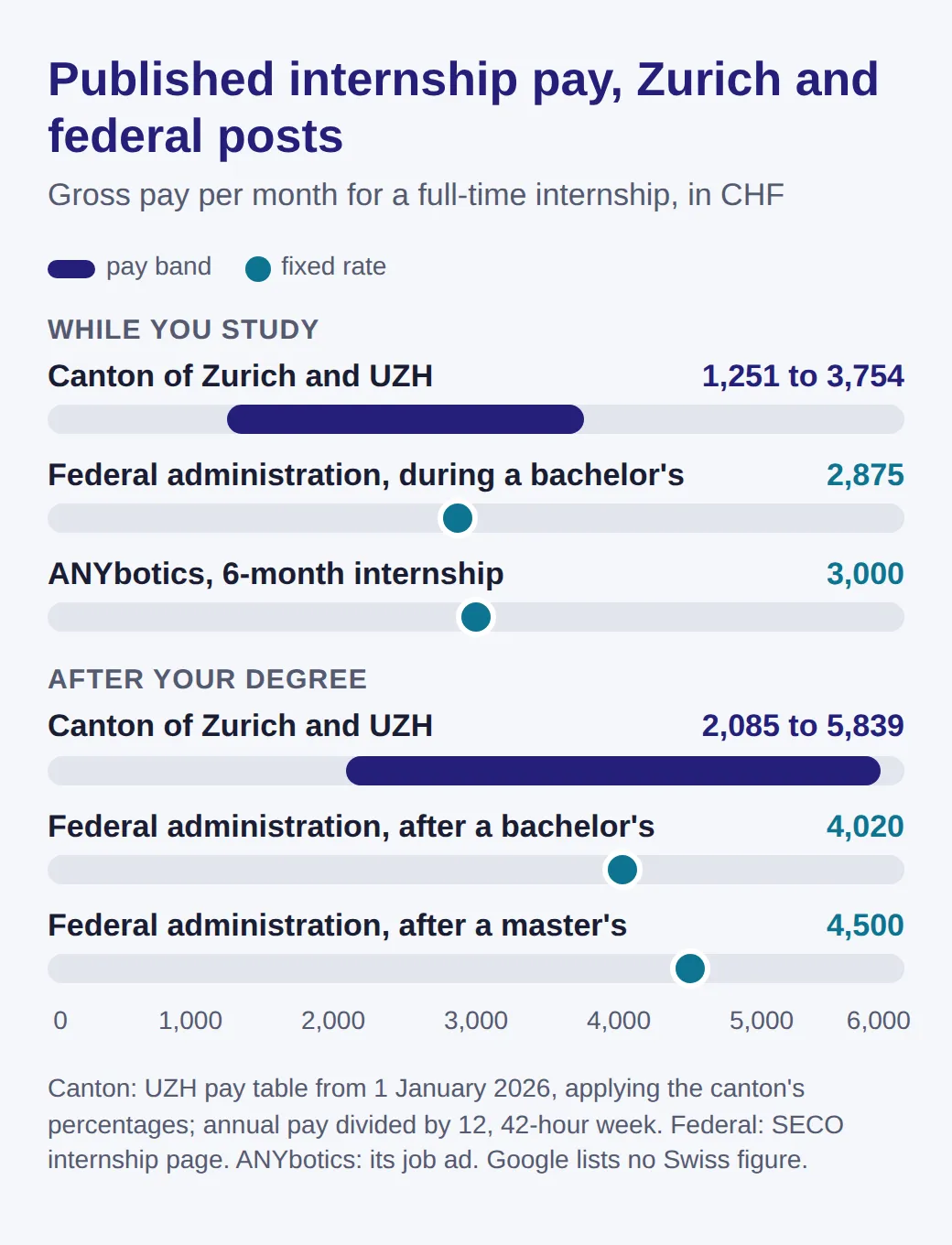
None of the private programmes in our table besides ANYbotics prints a figure, so these numbers are the closest thing to a public floor. Whether you can take any of these places at all depends on one question your university answers, not the employer.
Does your internship have to be compulsory?
Only if you are from outside the EU, and even then not always. A voluntary internship in the semester break is allowed once you are six months into your studies. But a compulsory internship is what allows full-time work during term, and it is the only way a student enrolled abroad can intern in Zurich at all. So the first thing to check is not the job ad but your own study regulations.
At UZH, the bachelor's in computer science includes a compulsory module, the Informatikpraktikum. It needs at least 12 working weeks full time at a company, usually in the summer break, with at most one week overlapping lectures. The institute must approve your project description before you start and does not recognise an internship after the fact. You finish with a three-page report, a ten-minute presentation and a copy of your work reference. Keep the paperwork: ANYbotics, for one, asks students from outside the EU for a letter from the university showing the internship is mandatory.
ETH's student portal says only that foreign students may work up to 15 hours a week during the semester and as much as they like in the breaks, after getting a work permit. We found no ETH page that makes an internship compulsory in computer science, so ask your department before you promise an employer a letter.
If you study abroad, the canton of Zurich sets narrow terms:
Note the quarter rule in the middle: the company's short-term foreign staff may not exceed a quarter of its workforce. A small start-up can hit that limit quickly. The rest of the rules depend on your passport.
Work rules for students from outside the EU
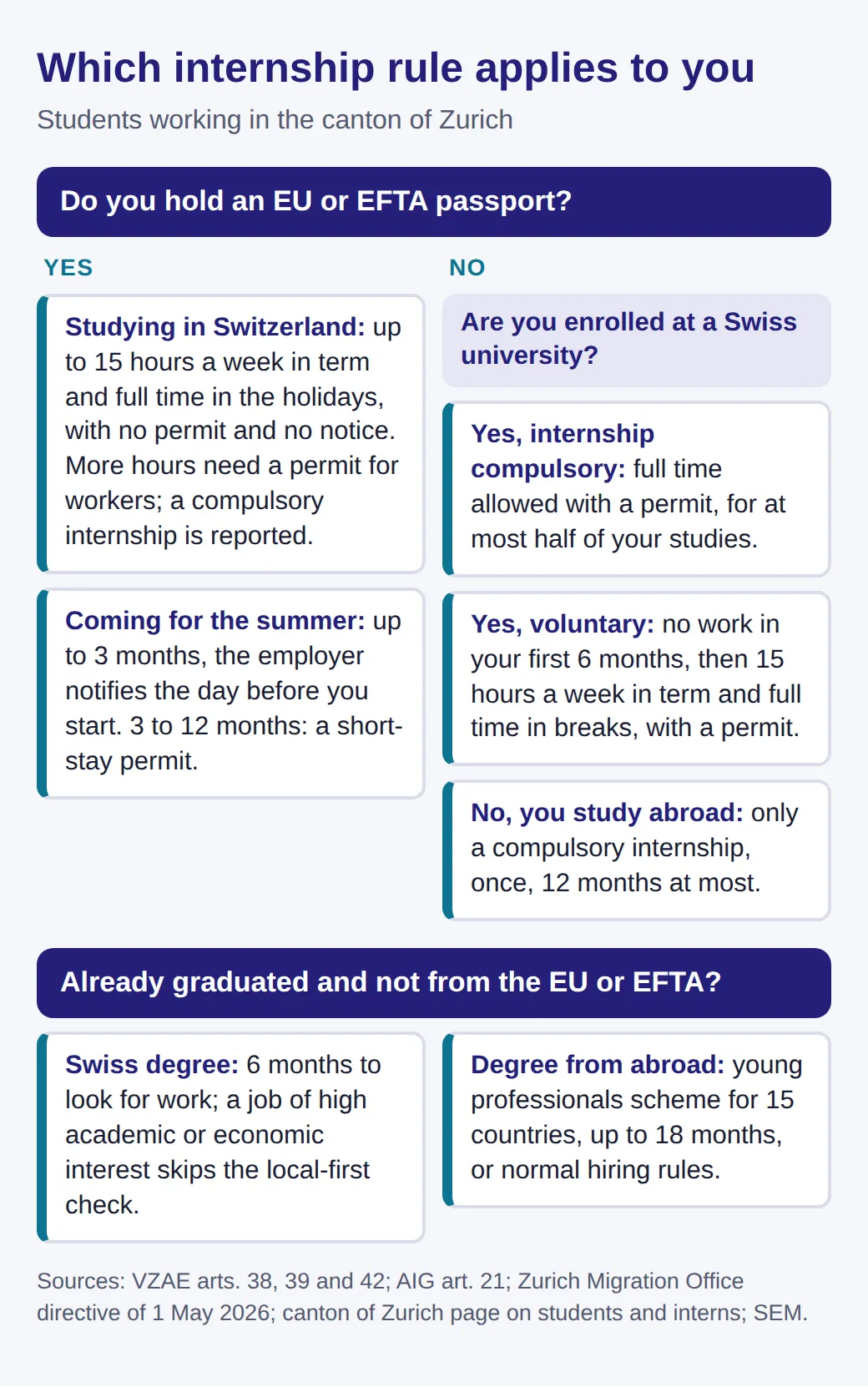
Students from outside the EU and EFTA can work in Zurich during their studies, but only with a permit that the employer requests, and for an ordinary side job only after their first six months.
The rule is article 38 of the federal ordinance on admission (VZAE). A permit for a side job can be granted no earlier than six months after your studies begin, if your university confirms the work is compatible with your studies and will not delay your degree, if you work no more than 15 hours a week outside the holidays, and if the pay is customary. The 15-hour cap applies only during term. In the semester breaks, a summer internship can be full time.
A compulsory internship follows article 39 instead. There is no weekly cap, but the paid work may not exceed half of the total length of your studies, and again the employer applies and the pay must be customary. The canton of Zurich applies both rules and adds that the employer files the application.
Plan for the paperwork taking time. Zurich University of the Arts tells its international students that applications can take up to three months and that nobody may start before the permit is valid. An offer signed in May for a start in June is cutting it fine. EU students face far less of this.
EU and EFTA students: the same 15 hours, without the forms
If you hold an EU or EFTA passport and study in Zurich, you can take a summer internship without a permit. The Zurich Migration Office's directive on free movement, in force since 1 May 2026, lets students and doctoral students work up to 15 hours a week, and full time in the holidays, with no permit and no notice. Above 15 hours in term, you need a residence permit for workers. A compulsory internship must be reported to the Migration Office.
If you study elsewhere in Europe and come only for the summer, the length of the contract decides. A job of up to three months goes through a simple notification, which the employer must file by the day before you start. A contract of three to twelve months gets a short-stay permit, which you request when you register with your municipality; our first 30 days checklist covers that registration. Part-time contracts usually need at least 15 hours a week to count as a job.
One group falls between the rules. The free movement agreement has not covered British nationals since 1 January 2021, so a British student who arrived after that is treated like any student from outside the EU. Graduation changes the picture again.
After graduation: internships need another route
Once you have your degree, the student rules no longer apply. EU and EFTA graduates can take an internship like any other job. Graduates from elsewhere have three routes.
If you graduate from a Swiss university, you can get a six-month permit to look for work, provided you have the money, housing and your diploma. A job of high academic or economic interest can then be approved without the usual check that no Swiss or EU candidate was available, under article 21 of the Foreign Nationals Act. The canton says it only considers sectors short of workers, gives research and development or new technologies as examples of high academic interest, and has the employer apply.
If your degree is from abroad, the federal young professionals scheme allows up to 18 months of work in your field for nationals of 15 countries: Argentina, Australia, Canada, Chile, Indonesia, Japan, Monaco, New Zealand, the Philippines, Russia, San Marino, South Africa, Tunisia, Ukraine and the USA. It needs at least a bachelor's or a two-year apprenticeship and full-time work paid at local rates, and you apply through the authorities in your home country.
The third route is an in-company internship of up to 18 months, which the canton allows when you are training for a later job with the same group abroad. Outside these three, a graduate intern is hired under the normal rules for workers from outside the EU, which means the employer must show that no suitable Swiss or EU candidate could be found.
What to do before March
Start with your own university, not the job ads. If your degree makes an internship compulsory, get the approval or letter now. For UZH students, the project description must be approved before the first day.
Then work through the calendar. At Google, the Student Researcher listing closes on 13 December 2026 and the PhD internship on 14 December. Set job alerts at UBS and Zürcher Kantonalbank before January, because both open their summer windows early in the year and UBS limits you to three applications. Look at ETH spin-offs and other start-ups at any time, and read the line in each ad about who can apply. ETH's VIS Kontaktparty, which our guide to tech meetups covers, brings more than 80 IT companies to ETH once a year; the next one is on 13 March 2027.
If you come from outside the EU, tell every employer early that they will need to apply for your permit, and allow three months for it. A summer offer is only useful if the permit arrives before the summer does.
Common questions
- Is an unpaid software internship allowed in Zurich?
- Not as a way around the permit. Swiss law counts work as gainful employment whether or not you are paid, so a student from outside the EU needs a permit either way. And the permit is only granted if the pay and conditions are customary for the place and the sector, which rules out working for free.
- Can I start my internship while the permit is still being processed?
- No. Zurich University of the Arts tells its international students they may only start with a valid permit and that applications can take up to three months. For a student from outside the EU, ask the employer to file as soon as you sign. For an EU or EFTA citizen on a job of up to three months, the employer only has to notify the authorities by the day before you start.
- Do British students follow the EU rules?
- No. The Zurich Migration Office states that the free movement agreement has not applied to British nationals since 1 January 2021, apart from rights acquired before that date. A British student who arrived later falls under the rules for students from outside the EU.
- Is tax taken from internship pay?
- Usually yes, at source. A student on a B permit for studies who works is taxed at source, which means the employer deducts the tax from each payslip. Ask for the gross and the net figure before you compare two offers.
- Can I write my master's thesis at a Zurich company instead of doing an internship?
- Yes, and for students from outside the EU it follows the same rule as a compulsory internship. The canton of Zurich says foreign students at a Swiss university who want to write their thesis with a Swiss company can get approval, as long as the paid work stays under half of the total length of their studies and the pay meets local standards.
More posts
All posts
Software Engineer Jobs in Zurich: Companies Hiring in 2026
Which companies hire software engineers in Zurich? Our live listings on 17 October 2026: Google, ZKB, AI start-ups, the canton, and how agency ads work.

Tech Meetups in Zurich 2026: Who Runs Them, How Often
Tech meetups in Zurich, checked group by group: who runs each one, how often it met in the past year, the next dates, and how to use them in a job search.

Machine Learning Jobs in Zurich: Who Hires in 2026
Machine learning jobs in Zurich: who posted 50 AI, ML and data listings on our board in October 2026, what they ask for, and the routes in at ETH and UZH.