Do I Need German to Work in Zurich? Software Jobs 2026

What the ads say
Often you don't. On 17 October 2026, 126 of the 293 software engineering listings in the city of Zurich on our board asked for German, and 116 of those ads were written in German. Of the 145 ads written in English, only 6 required it. The language an ad is written in is the best clue you have.
We read every one of those 293 listings in the language it was first posted in: 145 in English, 139 in German and 9 in French. For each, we noted whether it asks for German, accepts German or another language, calls German a plus, or doesn't mention it, and which level it names. These are counts of our own listings on one day, not a survey of the whole Zurich job market, and some ads appear more than once. The numbers below come from that reading unless a source is linked.
How many Zurich software jobs ask for German?
A little under half. Here is how the 293 listings split:
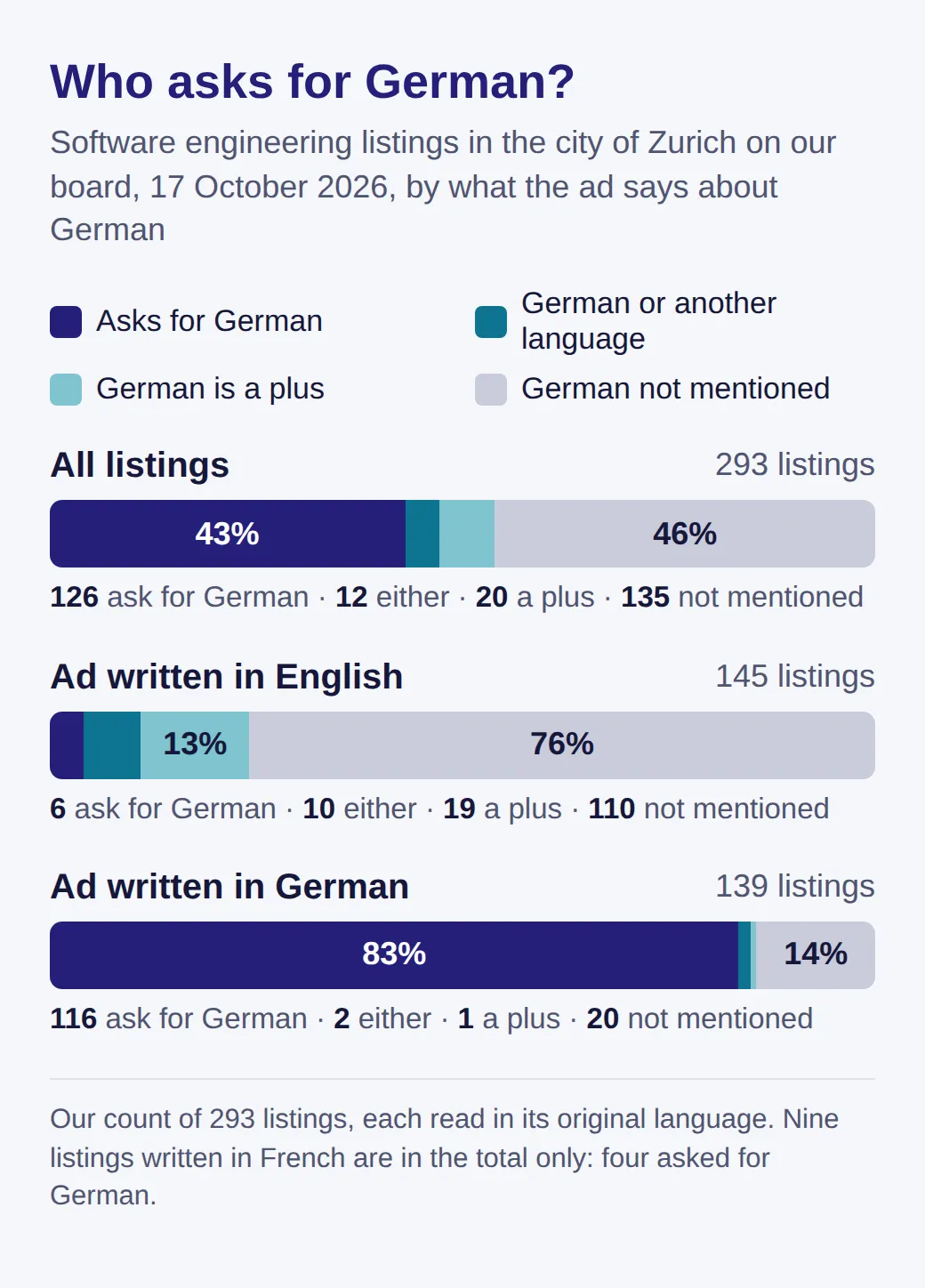
So 126 listings (43%) asked for German outright, 12 accepted German or another language, 20 said German was a plus, and 135 (46%) didn't mention it at all. Some employers and agencies post the same job several times. If you count each employer's job title only once, 95 of 248 distinct ads asked for German, which is 38%.
Recruitment agencies pull the share up. They posted 78 of the listings, mostly in German, and 60 of those asked for German, more than three in four. Of the other 215 listings, nearly all posted by the employers themselves, 66 did, or 31%. If you're looking only at English-speaking roles, much of the agency volume on a Zurich software board isn't for you.
The bigger split, though, runs along the language of the ad itself.
The language of the ad tells you most
An ad written in German almost always wants German, and an ad written in English almost never does. Of the 139 German ads, 116 named German as a requirement. Of the 20 that didn't mention German at all, many came from Swiss firms such as VZ VermögensZentrum and comparis.ch, and you would still be reading a German job description to apply. Only one German ad, for an Avaloq developer at LGT, said German was merely "von Vorteil", an advantage.
Of the 145 English ads, 110 didn't mention German, 19 called it a plus, and 10 accepted it as one of two options. The six that required German were mostly for jobs facing customers: three at Blockstream and one each at BLP Digital, HappyRobot and an agency.
The pattern holds even inside one company. Digitec Galaxus had seven listings: six were written in German and asked for German, from "mind. B1" for one senior engineer to "verhandlungssicheres Deutsch" (fluent enough to negotiate in) for a full-stack architect. The seventh, in English, wanted "Fluent English (working language); good German is a plus". One of the German ads even calls English the working language and still asks for German.
You see the same split at SIX, where two English ads called German a plus and the German one required it, at Vontobel (three English ads with German as an advantage, one German ad requiring it), and at Swisscom and Zurich Insurance. A team that writes its ad in English is far more likely to work in English. So filter by the ad's language first, then read its language line, and look next at who the employer is.
Which employers work in English?
Big tech companies and the younger product companies, as long as the job doesn't put you in front of Swiss customers.
Google had 33 listings on our board, counting those under Google Switzerland, and none of them asked for German. The only one that named the language was a partner-facing engineering role for Google Cloud, which needed "French or German fluently as this is a customer-facing role". NVIDIA's eight listings, Microsoft's two and the ads from Databricks, Snowflake, OpenAI and Anthropic didn't mention German either.
Younger companies hiring in Zurich look much the same. DeepJudge, RIVR, Langfuse, BJAK, Auterion, Jua and Odyssey posted 23 listings between them with no German line at all. Smallpdf went further and asked for the CV "in English, as it's the standard working language at Smallpdf". At ETH Zurich, a flight software role for space missions put it plainly: "German is an advantage but not required."
The catch is the customer. BLP Digital, which builds AI agents for ERP systems, called German a plus for several engineering roles, but for its ERP integrations role "Proficiency in German is a requirement, as the majority of our customers are based in the DACH region". Salesforce's forward deployed engineers, who build inside customers' systems, needed English and "at least one of German or French". HappyRobot advertised for a "German-speaking Forward Deployed Engineer" by title. And Blockstream asked for "Swiss German, German, and English" for a solutions architect, while its DevOps engineer only needed English.
If you want an English-only job, a back-end, platform or research role at an international firm is the safest bet. Customer-facing titles such as solutions engineer, presales or forward deployed engineer often bring German back in. Banks and public employers are a different picture.
Banks, the public sector and agencies ask the most
Swiss banks, cantonal employers and the agencies that fill their roles nearly always want German, often at a high level.
All eight listings from Zürcher Kantonalbank (ZKB) were written in German, and seven asked for German, most of them for "Sehr gute Deutschkenntnisse", very good German. All four of Raiffeisen's listings did the same, and so did all six from Pro Informatik, most of them for banking software. The public sector was stricter still: the City of Zurich wanted German at native level for a developer on public transport timetable data, and the Canton of Zurich asked for "stilsicher" German, meaning polished writing.
Agencies follow their clients. Evergreen Human Resources posted 20 listings, all asking for fluent English and good to very good German. ITech Consult's 16 German ads all gave a level, most often C2, and several said English was only "nice to have". Consult & Pepper's 12 ads, all for roles at ZKB, wanted German at C1 or above. Our post on who hires software engineers in Zurich explains how agencies work and what to ask them.
There are exceptions in finance, as the SIX and Vontobel ads show. But when a bank's ad is in German, expect your German to be tested in the interview. The next question is how much German these ads mean.
How good does your German need to be?
Usually B2 or better when the ad gives a level, and C1 most often. Of the 126 listings asking for German, 40 named a level: 22 asked for C1, 10 for C2, 5 for B2, 1 for B1 and 2 for native German. The levels come from the Common European Framework of Reference (CEFR), which runs from A1, a beginner, to C2, near native.
Most ads use words rather than levels, and the words are loose. Three ads tied the same word, "verhandlungssicher", to B2, C1 and C2. Here is what the common phrases mean:
| Phrase in the ad | What it means | How ads on our board used it |
|---|---|---|
| Muttersprache, Muttersprachniveau | native or native-like | City of Zurich, one agency ad |
| verhandlungssicher | fluent enough to negotiate | paired with B2, C1 or C2 |
| fliessend | fluent | Pro Informatik, Evergreen (for English) |
| sehr gute Deutschkenntnisse | very good German | ZKB, Raiffeisen, SIX |
| gute Deutschkenntnisse | good German | RUAG, isolutions, Vontobel |
| von Vorteil | an advantage, optional | LGT; English ads say "a plus" |
Read "in Wort und Schrift" (spoken and written) as a sign that you will write German too: specifications, tickets or emails to the business side.
Set those levels next to what the law asks of you if you stay in Zurich, and the gap is striking:
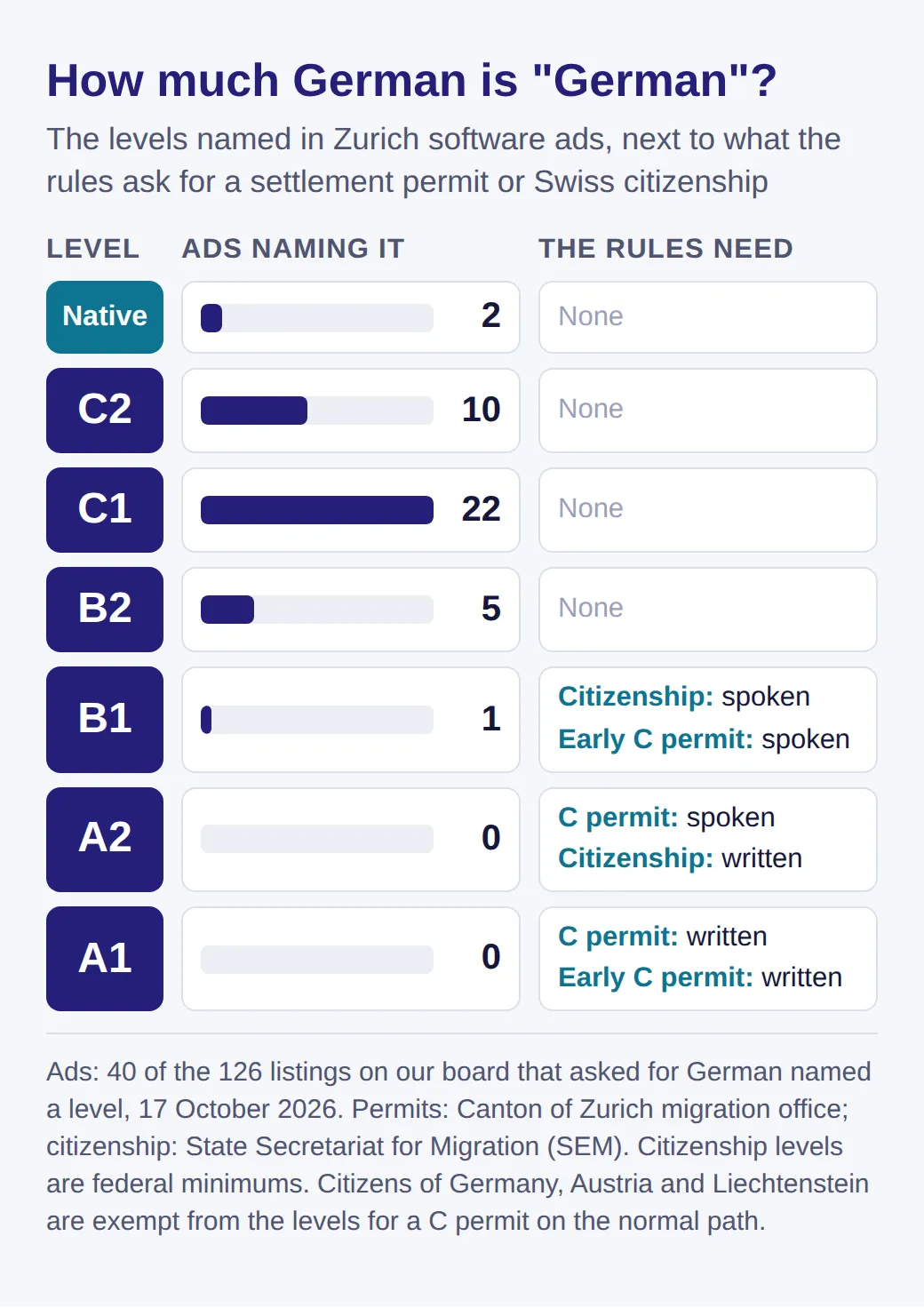
An employer who asks for German usually wants far more than a permit ever will. That matters for planning, because a course that gets you to the permit level won't get you most of these jobs. And the levels say nothing yet about the German you hear in the office.
What about Swiss German?
You will hear it every day, but very few ads ask you to speak it. In the German-speaking part of Switzerland, 83% of working people usually speak Swiss German at work, 43% Standard German and 21% English, according to the Federal Statistical Office's 2022 report on languages, which uses 2020 data. People could name more than one language. The share speaking Swiss German at work there fell from 89% in 2010, while English rose across the country.
Our listings fit that. Only 12 of the 293 asked for Swiss German in any form. Nine were for ZKB roles, posted by ZKB itself or by Consult & Pepper, and they asked for "Verständnis von Schweizerdeutsch", understanding it, on top of very good or fluent Standard German. The other three were Blockstream roles. The German ads we read were all written in Standard German.
So the order is clear: learn Standard German first, then learn to follow the dialect. Swiss German courses often assume the first step. One course in the city's database, for expats, lists B1 Standard German as a requirement. That doesn't make the dialect a small thing, though. In the Federal Statistical Office's 2024 language survey, about a quarter of residents whose main language differs from the local one said they had met language difficulties at work or when looking for a job. Your job may run in English, but your permit runs in German.
German for your permit and Swiss citizenship
For your first work permit, German isn't a condition. The Zurich migration office's overview of language requirements doesn't list one. German becomes a condition later.
For a settlement permit (C) on the normal path, the canton asks for spoken German at A2 and written German at A1. For an early C permit, it asks for B1 spoken and A1 written. Citizens of Germany, Austria and Liechtenstein are exempt from the normal-path levels. For Swiss citizenship, federal law asks for at least B1 spoken and A2 written, and cantons may set higher levels, as the State Secretariat for Migration explains.
You prove the level with a certificate. The migration office accepts telc, Goethe, ÖSD, SDS, TestDaF, KDE and fide certificates. Proof also counts if German is your mother tongue or you studied in German. This is where a job in English can catch up with you: years in an English-speaking team can leave you short of A2 if you never practise, so it pays to start early. Zurich makes that fairly easy.
Where to learn German in Zurich
Start with free advice, then pick a course that fits around work. The city runs a Welcome Desk at the Stadthaus on Stadthausquai 17 that advises on German courses free of charge, without an appointment. Across the canton, the Deutschkursberatung does the same for free, run by the training organisation ECAP with the canton's support.
The city's German course database listed 444 courses in mid-October 2026, with filters for evening and Saturday classes, small groups and level. Some courses are part-funded by the city, with lower prices for people who live in the city of Zurich. ECAP's standard courses from A1 to B2 cost Fr. 505 including materials, but meet twice a week in the morning or afternoon, which is hard to fit around an office job. Its speaking course meets at lunchtime instead:
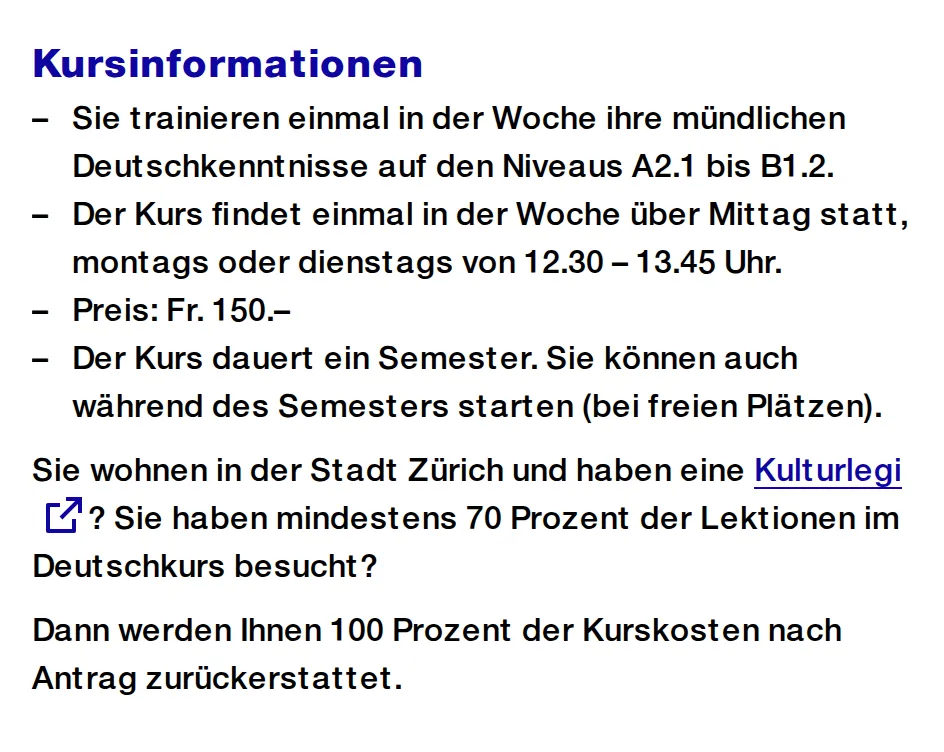
If money is tight, the city refunds the full cost of these subsidised courses to residents with a KulturLegi, a discount card for people on low incomes, once they have attended at least 70% of the lessons. For Swiss German, the same database listed 28 courses, at CHF 19.75 to 40 a lesson.
Ask your employer, too. Both GetYourGuide listings on our board named a "Language reimbursement program", and Swisslinx offered "support for German or English language development". People who arrived as adults often learn the language this way: in the 2024 survey, among first-generation migrants who know a national language that isn't their main one, 41% said they had learned it at work, and as many on a course.
Before you apply
Sort the listings by the language of the ad. English ads at international firms are where German is least likely to stop you. A German ad that names C1 means it: expect to be interviewed at least partly in German. When an ad calls German a plus, believe it: English is enough to apply.
Then give your level honestly, as a CEFR level with the proof behind it. A line like this tells a recruiter more than "basic German":
German: B1, Goethe-Zertifikat (2026), taking an evening course towards B2. English: C2.
If you're new in Zurich, book a course in your first months, even if your team works in English. The ads say you can get hired without German. The permit rules say you'll need some to stay.
Common questions
- Can I use French or Italian instead of German in Zurich?
- Sometimes, mostly in customer-facing roles. Salesforce asked for English plus German or French, and one agency ad accepted German or French at B2. For a permit or Swiss citizenship, though, the canton of Zurich asks for German.
- Do I need German to get a Swiss work permit?
- Not for a first permit to work. The Zurich migration office's list of language requirements covers the settlement permit (C), family reunification and a few special cases, and a first work permit is not on it. German becomes a condition later, when you apply for a C permit or a Swiss passport.
- Does my partner need German to join me in Zurich?
- If you are not an EU or EFTA citizen and hold a B or C permit, yes, at a basic level. The canton asks a partner joining you for spoken German at A1, or proof that they have signed up for a course that leads to it. Illness or a disability can be grounds for an exception.
- Will my employer pay for German lessons?
- Some say so in their ads. Both GetYourGuide listings on our board named a language reimbursement programme, and Swisslinx offered support for German or English. Many employers have a training budget without naming it in the ad, so ask about it once you have an offer.
- Should my CV be in German if the ad is in German?
- We would match the ad. If it is written in German and asks for C1, a CV and a short cover letter in German show the level better than any line on your CV can. If the ad is in English, apply in English and state your German level honestly.
More posts
All posts
Software Engineer Jobs in Zurich: Companies Hiring in 2026
Which companies hire software engineers in Zurich? Our live listings on 17 October 2026: Google, ZKB, AI start-ups, the canton, and how agency ads work.