Machine Learning Jobs in Zurich: Who Hires in 2026

In one minute
On 17 October 2026, our board had 50 Zurich listings in which AI, machine learning or data work is the job itself. Google posted 12 of them and NVIDIA 5. The rest came from AI labs and start-ups, other tech firms, ZKB and SIX, three recruitment agencies, a forensic institute and ETH Zurich. Not one of the 50 had "machine learning" or "ML" in its title.
Those are counts of our own listings, not a census of the Zurich market. softwareengineerjobszurich.ch had 293 live software engineering jobs in the city when we counted. We read the 79 that our board tagged AI/ML or Data, or that came up in a search for machine learning, and kept the ones where building, training, deploying or running AI and data systems is the main work. A plain backend job at an AI start-up didn't count; a backend job building the platform that serves the models did. Some listings are copies of each other: four NVIDIA listings share one text, three Salesforce listings one title and text, one Google DeepMind role appears three times and LatticeFlow AI's two listings are the same ad, so the 50 listings stand for 42 different ads. For the wider list of who hires software engineers in Zurich, see our employer overview.
Why "machine learning engineer" finds so little
Because employers rarely use the phrase. None of the 50 titles contains "ML" or "machine learning": 15 contain "AI", three contain "Data", and the other 32 none of these words. The machine learning is in the team name or in the job text, not in the title.
| Title in the ad | What the work is | Example on our board |
|---|---|---|
| Software Engineer, Senior or Staff | A product team that ships models | Google, Gemini and Search |
| Member of Technical Staff | Engineering at an AI lab, close to research | Odyssey, Jua |
| Research Engineer | Training and improving models | Anthropic, post-training |
| Forward Deployed Engineer | Building AI systems with a customer | OpenAI, Salesforce |
| AI Engineer, AI Architect | Bringing AI tools into the company's own work | ZKB, SIX |
So search for what the model does (search, recommendations, inference, computer vision) and for team names such as DeepMind or Applied AI, not only for the job title. Grouped by the work itself, the 50 listings fall into five kinds, starting with the smallest.
Who hires for model and research work?
Nine listings involve training models or doing research with them, and they come from AI labs, start-ups, Google and two public employers.
Anthropic's one Zurich listing is for a research engineer on the post-training team, the people who turn a base model into the one customers use. The ad says staff are expected in an office at least 25% of the time and that the company sponsors visas, though "not for every role and every candidate". Odyssey, an AI lab building what it calls "general world models", wants 1+ years of software engineering with serious work on ML performance for its core model engineering role, plus 2+ years of ML and PyTorch, TensorFlow or JAX.
Google had three listings here. A Software Engineer III role in Search Ads trains, evaluates and deploys models, and asks for three years of C++ and Python, or one year with an advanced degree, plus two years of deploying large language models (LLMs) and deep learning models. A research software engineer post in artificial life runs large simulations for frontier machine learning research, and a computer vision role for smart glasses and headsets lets you choose Zurich or Munich.
The rest are small and varied. Marble is looking for a co-founder and CTO to build "physical AI" for process plants. The Forensisches Institut Zürich, a public institution of the canton and the city, wants a specialist for forensic analysis of images, video and audio who also builds AI tools, starting on 1 January 2027 and with very good German. Flink Robotics, out of ETH's Computational Robotics Lab, offers a computer vision and ML role to a student or recent graduate, with C++, PyTorch and CUDA, and says it cannot sponsor a visa for it. ETH's own AI for Science Engineer is covered further down. Product teams hire in larger numbers.
AI inside products: Google leads
Twelve listings are for engineers who build AI into a product people use, and seven of them are Google's.
Google's Zurich teams were hiring for Gemini and Search, generative AI in shopping (Commerce), an Applied AI team building LLM and language understanding infrastructure, and the machine learning infrastructure behind its Home and Health products. Most of these are senior: the Staff role in Commerce asks for eight years of software development and five of leading ML design and infrastructure. The oddest of the group is a single Google DeepMind role listed three times, RTL Optimization, where software engineers work with AI agents on chip design. It requires eight years of coding and prefers two years of hardware design experience on top.
Outside Google, the AI Lab at Avaloq, which makes wealth management software for banks, wants an AI software engineer with five years of full-stack work, three of applied ML and two with LLMs. BJAK had two roles building AI agent systems, where the ad stresses latency, reliability and cost when models answer users in real time. Jua, which describes itself as "a research team in Zürich" building AI weather models, wants an engineer to bring its models to production and requires that you already live in Zurich. BLP Digital offered two six-month engineering internships testing and chaining AI models. The most common title in our count is a newer one.
Forward deployed engineers
A forward deployed engineer builds AI systems inside a customer's company, and with ten listings it was the most common job title in our count, in one form or another.
OpenAI's ad says the role is based in Zurich, with three office days a week, help with relocation and up to 50% travel. Salesforce had three listings for a Lead Forward Deployed Engineer, asking for seven or more years of software or technical delivery work, hands-on LLM experience, and about 25% travel. Google Cloud had two, at senior and senior staff level, both asking for eight years of experience. LatticeFlow AI, an ETH spin-off selling AI governance software, had two; BLP Digital and HappyRobot one each.
These ads want people who build with models rather than train them: 8 of the 10 mention LLMs, and none mentions PyTorch. They also depend on language more than any other group. Five of the ten require German or French because you work face to face with Swiss customers: the three Salesforce ads, one Google ad and HappyRobot's, which is titled "German Speaking". Our guide to German at work in Zurich covers how much that matters in the rest of the market. Below the customer work sits the plumbing.
The infrastructure under the models
Fourteen listings, the largest group, are for engineers who build the systems that move data and serve models. This is where strong systems programmers fit best.
NVIDIA posted five. Four share one ad for its AI networking acceleration team, which works on an open-source library using GPU kernels and RDMA network cards (hardware that moves data between machines without the CPU) for "a highly optimized inference framework". It asks for eight years of modern C++, C or Rust. The fifth, a senior architect for HPC and AI networking, is the only one of the 50 listings that names a PhD as a requirement, and even there "equivalent industry experience" will do.
The AI labs need the same kind of engineer. Odyssey wants someone to run its low-latency inference platform, and Jua a backend and infrastructure engineer with three years of experience. Langfuse, an open-source LLM engineering platform, had three roles, though its ads say the team sits in Berlin and San Francisco and expects one week a month in Berlin. The data side is here too: Databricks wants 15+ years for a senior staff role on its Delta Lake storage layer, Swisscom a data platform engineer with Kubernetes, Kafka and very good German, Abraxas a data migration engineer at Zürich-Flughafen, and DeepJudge a backend engineer for the search index behind its legal AI. Rust appears only in this group, in 5 of its 14 ads. Financial firms hire for AI too, but mostly for their own use.
AI for the company's own work
Five listings are for engineers who bring AI tools into a company's own operations, mostly its software development, and three of them come through recruitment agencies.
Zürcher Kantonalbank (ZKB) is hiring an AI engineer to design and build "AI-native solutions for software development" for its IT, at 80–100% and with very good German. SIX, which describes itself as financial market infrastructure, wants an AI software architect to set the rules for AI-assisted and agent-based coding, work it says will touch more than a thousand engineers. It asks for eight or more years, allows up to 40% of the week at home, and counts German as a plus.
The agency ads are narrower. ITech Consult is filling a 12-month contract at a Swiss bank for a generative AI solution architect, who will connect the bank's Genesys contact centre software to its generative AI platform. The ad asks for German at C2 level. Yellowshark is recruiting a Microsoft Copilot and AI engineer for Copilot Studio and Azure, and its ad was the only one of the 50 to state pay: CHF 110,000 to 120,000 a year. A third agency, avecco, wants a principal engineer who codes with AI assistants. Across all five groups, the ads ask for similar things.
What the ads ask for
A degree, years of experience and, in most ads, some work with LLMs, but rarely a PhD.
None of the 50 listings strictly requires a doctorate. NVIDIA's architect role asks for a PhD or equivalent industry experience, the ETH AI for Science Engineer role prefers one but welcomes a master's with strong experience, and the forensic institute calls it an advantage. Ten Google listings list a master's or PhD as preferred, never as a minimum, and some Google ads count an advanced degree as experience: the Search Ads role asks for three years of coding, or one year with an advanced degree.
Experience is where the bar sits. Twenty-seven of the 50 titles say senior, staff, principal, lead, architect, founding or CTO. Thirteen ads ask for eight years or more and 11 for five to seven, while only six ask for three years or less and two are open to students: the Flink role and the BLP Digital internships. Eighteen give no number at all.
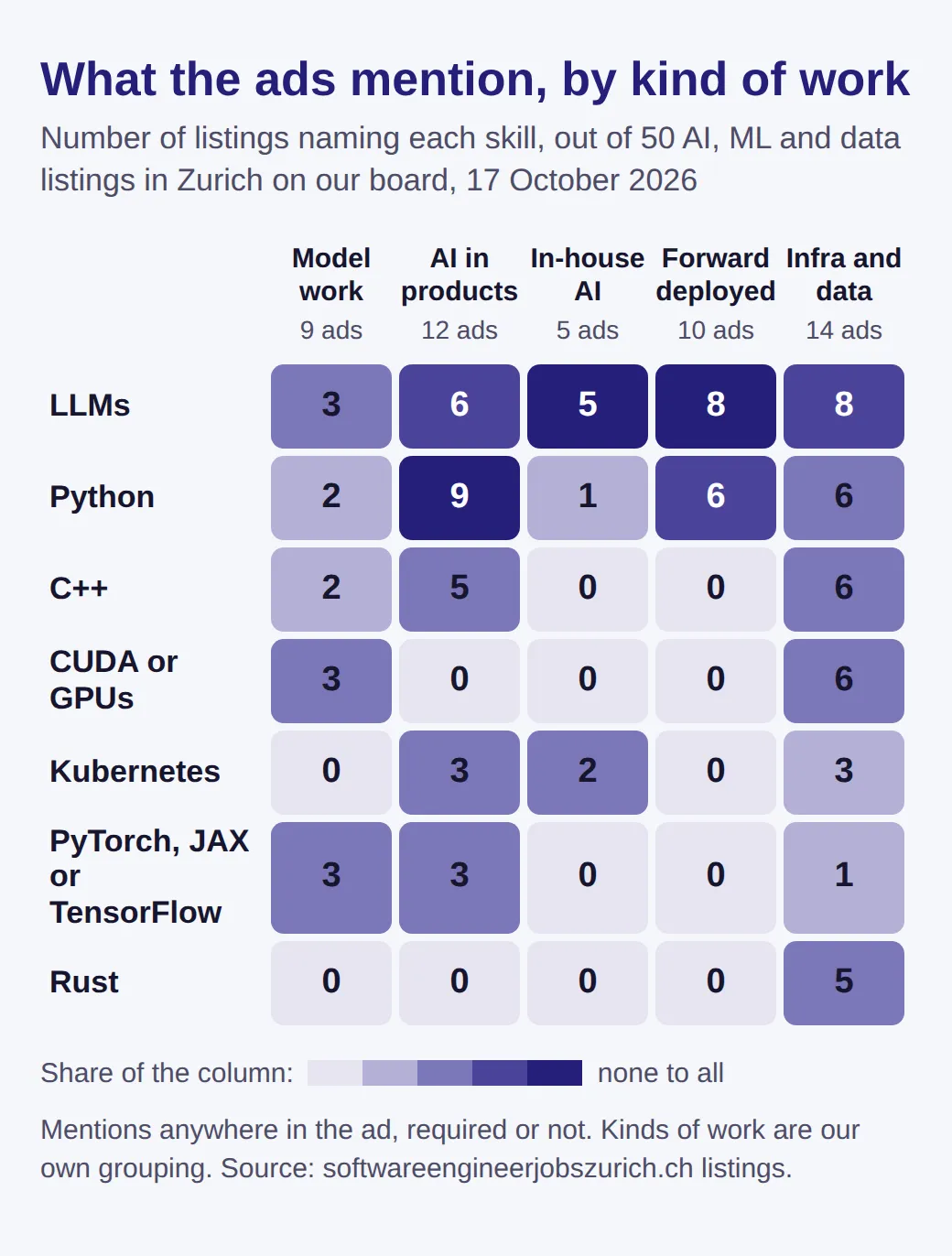
The skills tell you which door to try. LLMs come up in 30 of the 50 ads, Python in 24 and C++ in 13, while the classic deep learning frameworks (PyTorch, JAX or TensorFlow) appear in only seven, six of them in model and product work. If you are a C++ or Rust engineer, the infrastructure jobs are your way in; if you build with LLMs and speak German or French, the forward deployed roles are. Nine of the 50 require German or French, and the rest are written for English speakers. For research work, the universities have their own routes.
ETH Zurich and UZH: the academic route
Academic AI jobs in Zurich are mostly doctoral and postdoc positions, and they are filled in two ways: through a professor's own group, or through a few fellowship programmes with fixed deadlines.
ETH Zurich has 4,500 doctoral students, and apart from a few exceptions all of them are employed as scientific assistants, so a PhD there is a paid job in a research group. The computer science department warns that admission is highly competitive and that a doctorate typically takes four to five years. Outside the fellowships below, you approach a professor whose work fits yours directly, as the ETH AI Center's education page points out. ETH's job portal lists doctoral and postdoc openings with their own filters.
The ETH AI Center's doctoral fellowship is the most visible programme. Its faculty spans more than 140 professorships from all 16 ETH departments plus groups at the University of Zurich (UZH) and the University of St. Gallen, and each fellow is supervised by two mentors from different fields, with equal weight.
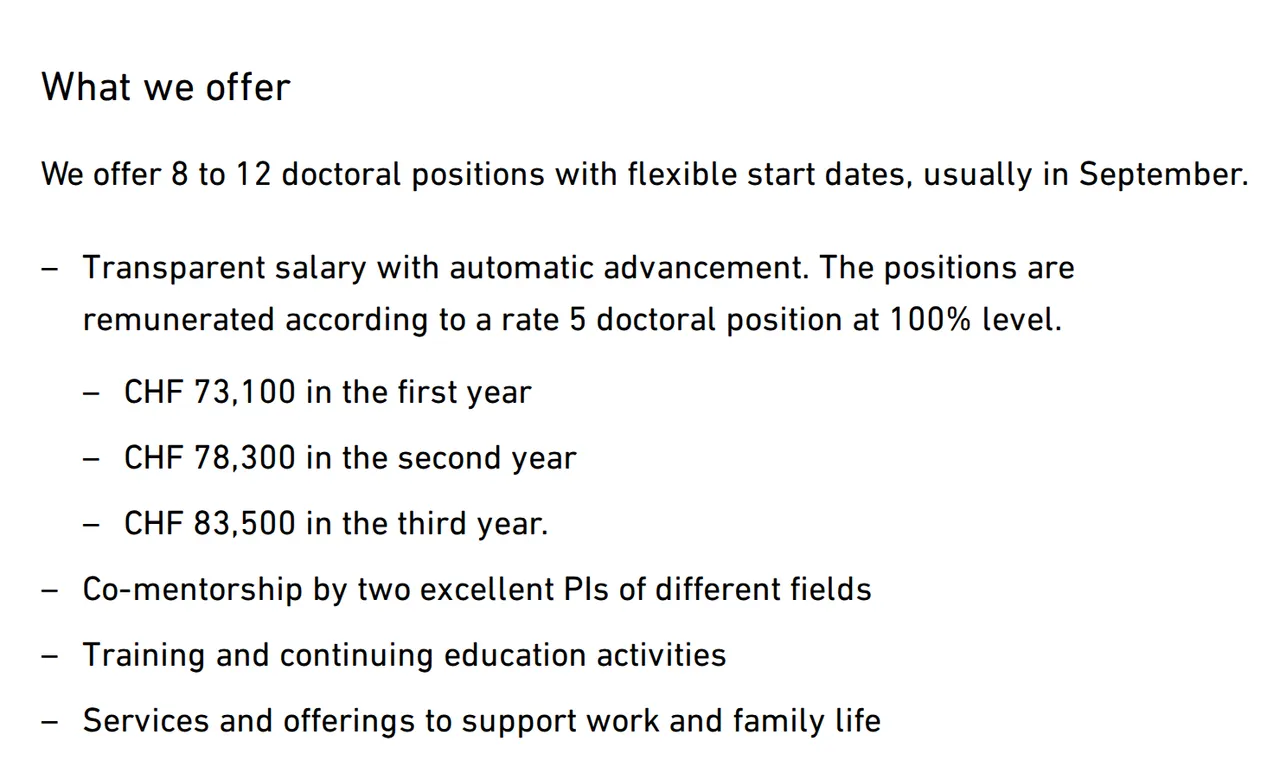
For places starting in 2027, you apply online by 27 October 2026 at 16:00, with transcripts, a motivation letter, a CV and a two- to five-minute video, and two referees must upload their letters by 2 November. You need a master's degree finished at least three months before you start, by June 2027 at the latest. Shortlisted candidates give a research talk at an online symposium on 1 and 2 February 2027. Two related programmes close days later. The Max Planck ETH Center for Learning Systems, where about 40 PhD researchers are supervised jointly from ETH and Tübingen, takes applications until 2 November 2026, and the European ELLIS PhD Program until 31 October 2026. ETH also hires engineers outside the PhD track: its AI Center's AI for Science Engineer listing on our board asks for typically one to three years of building LLM-based systems and is open to exceptional recent graduates.
At UZH, the Department of Informatics in Oerlikon lists its research groups, each with a link to its own PhD and postdoc openings. For machine learning, look at Robotics and Perception, Text Technologies, the Autonomous Sequential Learning and Predictive Intelligence Lab and Digital Linguistics. For data work, the Swiss Data Science Center, a national research infrastructure for data science and AI within the ETH domain, has its Zurich office in the same building as the ETH AI Center, at Andreasstrasse 5.
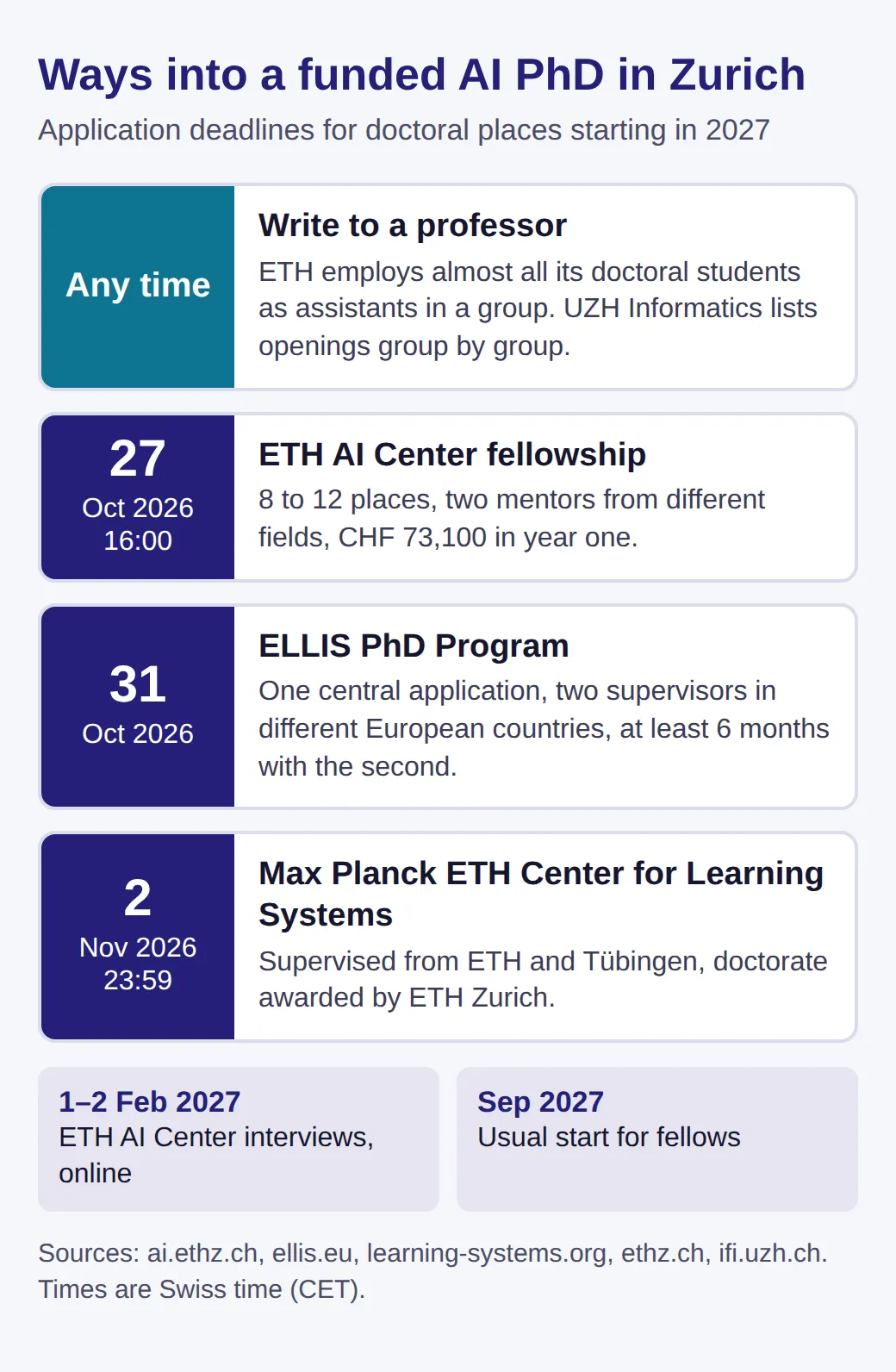
Writing to a professor has no deadline, while the fellowships interview in early February and usually start their fellows the following September. So if you want a fellowship place in 2027, you apply in autumn 2026.
Where to start
Pick the kind of work first, then search for it by team and task rather than by "machine learning" in the title. If you already build backends or systems, the infrastructure ads are the widest door, at NVIDIA, the AI labs and the data platforms. If you have shipped LLM features and speak German or French, the forward deployed and in-house roles want you more than they want a PhD. If you want research, be honest about the timing: for a 2027 doctorate, the ETH AI Center, ELLIS and CLS deadlines all fall between 27 October and 2 November 2026, and the ETH AI Center also needs your referees' letters by 2 November, so ask them now. Follow the employer pages linked above on our board, where listings change as roles open and close, and check each ad's location line before you apply.
Common questions
- Are data scientist jobs listed on this board?
- Only when the employer files them as software engineering. Our board covers software engineering jobs in the city of Zurich, so data scientist and analyst roles posted under other fields do not show up here. On 17 October 2026, none of the 50 AI, ML and data listings we counted had data scientist in its title. The data work we did find was engineering: data platforms, data infrastructure and data migration.
- Does a Zurich listing always mean you work in Zurich?
- Not always. Langfuse, which lists its roles in Zurich, says in its ads that its team sits in Berlin and San Francisco and expects one week a month in the Berlin office. A Google computer vision role lets you choose between Zurich and Munich, and one Snowflake listing shown in Zurich had Poland in its title. Read the location lines before you apply.
- What does a postdoc fellowship at the ETH AI Center pay?
- The ETH AI Center lists CHF 92,500 in the first year and CHF 97,200 in the second for its postdoctoral fellowships, which run for two years. It offers 8 to 12 places, usually starting in September. The deadline for 2027 places is the same as for the doctoral fellowship, 27 October 2026 at 16:00, and you need a finished PhD, or one finished by June 2027 at the latest.
- Can I study machine learning in Zurich before looking for a job?
- Yes. ETH Zurich offers a specialised Master in Data Science, and the University of Zurich offers Artificial Intelligence and Data Science as master's specialisations in informatics. Since autumn 2025, UZH also has a bachelor's degree in Applied Mathematics and Machine Learning. The Flink Robotics role in this article is open to students who are still finishing a degree.
More posts
All posts
Tech Meetups in Zurich 2026: Who Runs Them, How Often
Tech meetups in Zurich, checked group by group: who runs each one, how often it met in the past year, the next dates, and how to use them in a job search.

Software Engineering Internships in Zurich for Summer 2027
Who takes software engineering interns in Zurich for summer 2027, when to apply, what it pays, and the 15-hour and compulsory-internship permit rules.

Do I Need German to Work in Zurich? Software Jobs 2026
Do you need German for a software job in Zurich? We read all 293 listings on our board: 43% ask for German. What decides it, Swiss German, and courses.