80 Percent Jobs in Zurich: The Four-Day Week in Tech, 2026

The short answer
On 19 October 2026, 68 of the 287 software engineering listings for the city of Zurich on our board said you could work less than 100%, most often as a range of 80–100%. Banks, insurers and the public sector allowed it in almost half their ads, the US tech firms in none. At 80%, salary drops by a fifth, holiday weeks stay the same, and your pension fund savings can drop by more than a fifth.
Those figures are counts of our listings on one day, not a survey of the Zurich job market. We read every listing in English and in German and noted what each one says about the workload, which Swiss ads call the Pensum. Part-time work is common in Switzerland: in the last quarter of 2025, 38.6% of people in work had a part-time job, according to the Federal Statistical Office (BFS), which counts anything below 90% as part time. Among men it was 553,000 of 2.61 million, about one in five. Whether a software job lets you join them depends a lot on who posted it.
How common are 80% jobs in Zurich software engineering?
About one listing in four offers it, and the share swings widely by employer. Out of 287 listings, 68 (24%) allowed a workload under 100%, 44 (15%) said 100% and nothing else, and 175 (61%) didn't mention a workload at all. Of the 112 ads that did name one, most were open to less than full time.
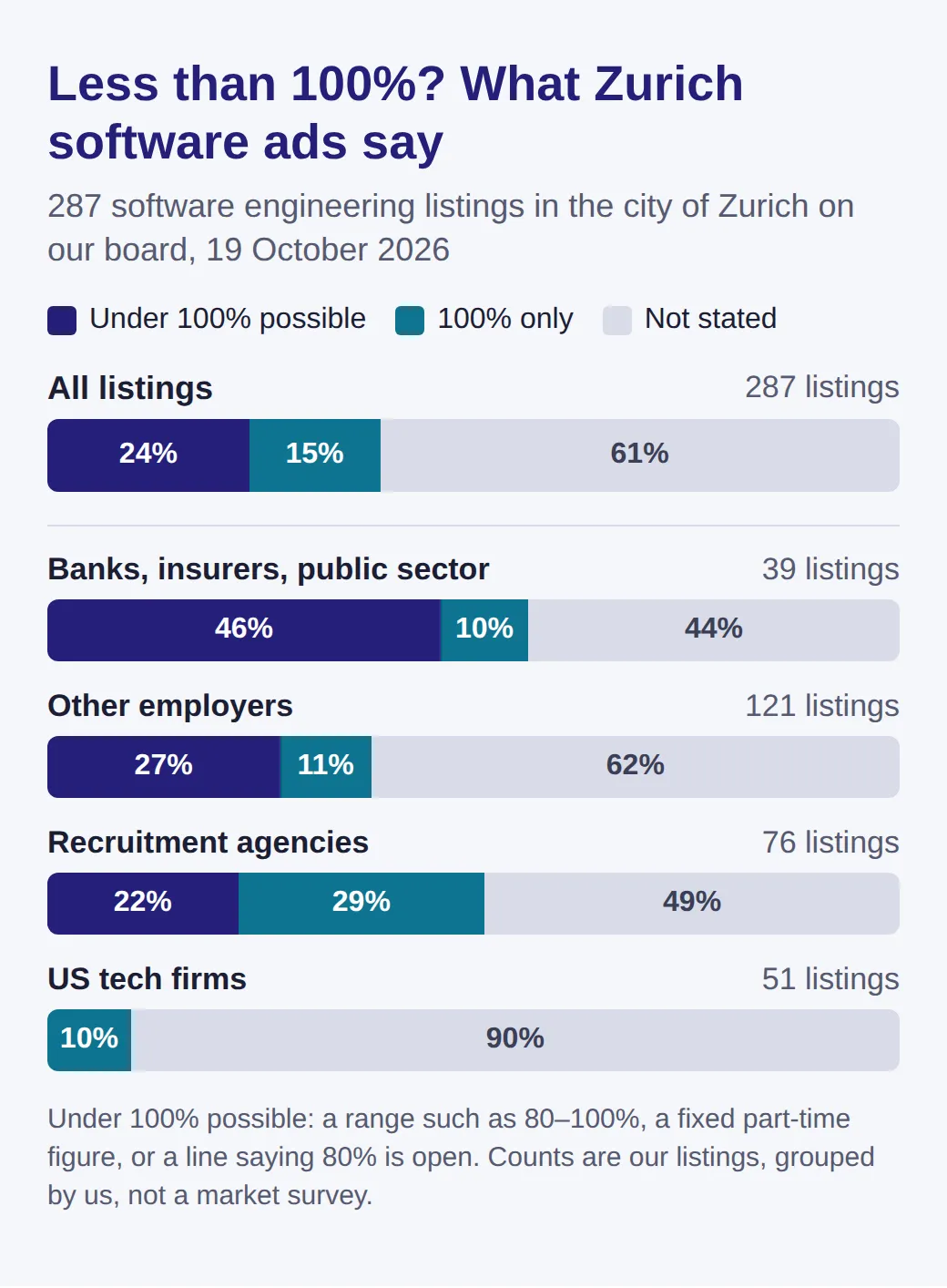
The usual form is a range. Of the 68, 49 gave 80–100%, three gave 60–100%, one 70–100%, one 50–100% and one "80% or more". Seven named a part-time figure only, such as 80% or 60–80%, and six were Digitec Galaxus ads with a line saying every position is open at 80%. Not one listing used the words "four-day week". In Switzerland the four-day week is a percentage, and you agree on the days afterwards.
Who writes it matters more than the job title. Look at the bottom of the chart: the 51 listings from US tech firms (Google, NVIDIA, Microsoft, Salesforce, Databricks and a few more) never mentioned a workload under 100%. Google's 33 said nothing at all about workload, and five of NVIDIA's eight said 100% in the title. That doesn't prove you can't ask, but nothing in their ads invites it. Recruitment agencies split the other way: 22 of their 76 listings said 100%, and 12 of those were contract roles. Of the 17 agency ads that allowed less, 12 came from one agency, Consult & Pepper, and were all for jobs at Zürcher Kantonalbank. We wrote about who posts these ads in our post on software engineering employers in Zurich.
Banks, insurers and the public sector
The financial and public employers were the most open: 18 of their 39 listings allowed less than 100%. All eight of Zürcher Kantonalbank's own listings carried "80% - 100%" in their header, and its ads list part-time work among the benefits. SIX, Zurich Insurance, LGT, the Canton of Zurich and ETH Zurich each had at least one listing with a range. Two of Raiffeisen's four ads named no figure but said the bank offers part-time workloads.
The City of Zurich went furthest. Its one listing, for an application manager and developer until February 2028, was for 60–80% and gave the pay for a 100% workload: CHF 100,000 to 115,000 a year, or 7,700 to 8,800 a month. We use that figure further down.
Digitec Galaxus: every role at 80%
All six of the online retailer's listings on our board carried the same line: any position can also be done at 80%. The roles ran from a junior software engineer to a software architect, so the offer isn't limited to one level. Other Swiss employers among the 121 listings we grouped as "other employers" were less uniform. Comparis, True Wealth, RUAG, Supercomputing Systems, Zurich Instruments and the poster company APG all gave ranges, while the robotics and AI start-ups mostly said nothing.
Knowing who is open to it is half the work. The other half is reading what a percentage actually promises.
What does 80–100% in a job ad mean?
It means the employer will accept any workload in that range, and that the exact figure is yours to agree. It doesn't mean the job is designed for 80%, and it says nothing about which days you work.
The percentage is measured against the employer's full-time week, which isn't the same everywhere. Abraxas, which had two 80–100% ads, states a 41-hour week at full time, so 80% there is 32.8 hours. At an employer with a 40-hour week, it's 32. A free day each week is the obvious way to use 80%, but nothing stops you from agreeing five shorter days or two free afternoons. Write down which you want before you ask.
Watch the classification too. Of the 55 listings with a range such as 80–100%, 40 were filed under "full time" in the job data, the label that search engines read. If you filter only for part-time jobs, you miss most of the roles that would let you work four days. Searching for "80%" or "Pensum" in the text works better, and many of these ads are in German, a topic we cover in do you need German to work in Zurich.
When the ad says nothing
The 61% of ads that name no workload are not a no. They simply don't tell you. Swisscom shows how much the wording can vary inside one company: its three listings under Swisscom (Schweiz) AG offered 60–100%, while its other listings named no figure. adesso wrote "Arbeiten in Teilzeit ist nach Absprache möglich (80-100%)", part-time by arrangement, in the middle of a paragraph about its culture, where a quick reader would miss it. When an ad is silent, the only way to find out is to ask, which leads to how and when to do it.
How to ask for a four-day week
Ask once the employer wants you and before you sign, and ask in writing. That's the short version; the reasons are in the law and in the ads.
Swiss law doesn't give you a right to work 80%. The Code of Obligations mentions part-time work exactly once in its chapter on employment, in article 319, to say that a part-time contract is an ordinary employment contract. Your workload is a term both sides agree, and once signed, it changes only if both sides agree again. This is why the moment matters: before an offer, you're one candidate among several; after signing, you're asking for a contract change. Between those two points, when the employer has chosen you, you have the most room.
If the ad gives a range, say your figure early, in the application or the first call: "I'm applying for 80%." The employer has already said yes in principle, and you avoid a surprise at the offer stage. If the ad says nothing, our advice is to raise it after the first interview, once there's interest on both sides, and to frame it as a working pattern you've planned, not a favour. If the ad says 100% only, ask anyway if the job matters to you, but expect a no. Contract roles leave the least room: of the 16 contract listings on our board that named a workload, 12 said 100%.
When the offer comes, reply with the details you want in the contract. A short email is enough:
Thank you for the offer, I'm glad to accept. Before I sign, could we fix the workload in the contract? I'd like to work 80%, four days a week, with Fridays off. Please state the salary at 100% and at 80%, the holiday entitlement in days, and send me the pension fund rules. Thank you.
The last request in that email is easy to forget, and the pension section below explains why it matters.
What happens to your pay at 80%?
Your salary falls by exactly 20%, and so does everything calculated from it: the 13th month's pay, where your employer pays one, and any bonus set as a share of salary. Take the City of Zurich's range. CHF 100,000 a year at 100% is 80,000 at 80%, and the monthly 7,700 becomes 6,160. That's why you should always ask for the salary at 100% as well: it's the figure you compare between offers, and the one you take back to 100% later.
The other half of pay is time. Hours above your agreed workload count as overtime under article 321c of the Code of Obligations. Your employer must give you the same amount of time off, with your agreement, or pay the hours with a supplement of at least 25%, unless your contract says otherwise in writing. Read the overtime clause before you sign, because a written contract can exclude that supplement. An 80% job that quietly fills five days is a 100% job at 80% of the salary.
Holidays at 80%: fewer days, same weeks
At 80% you keep the same number of weeks off, counted in fewer days. The law sets at least four weeks of holiday a year, five for employees under 20, and it counts in weeks, not days. On a four-day week, four weeks are 16 working days.
Most Zurich employers give more than the minimum. Digitec Galaxus's ads offer 25 days of holiday, APG's and the cantonal building insurer GVZ's at least five weeks, and Denner's six weeks. At 80% on four days, Digitec's 25 days become 20, still five weeks away from your desk. If your contract states holiday in days, check that it was recalculated for your workload, and in which direction.
Some employers offer another route to more time off, and it's worth comparing. Abraxas lets staff buy two extra weeks of holiday a year, and APG offers the same. The Canton of Zurich lets you top up holidays with flexitime hours you've built up. Two bought weeks on top of Abraxas's minimum of 25 days make seven weeks off while you keep a 100% workload. If what you want is a long summer, not a free Friday, ask how bought weeks are charged before you ask for 80%.
Does part-time work reduce your pension?
It can, by more than your salary does, and how much depends on your pension fund's rules. Switzerland's pension has three pillars, and 80% affects each one differently.
The first pillar, the state AHV pension, is the least affected. It depends on how many years you paid in and on your average income over your whole working life. The maximum pension, CHF 2,520 a month, goes to people with no missing years and an average income of at least CHF 90,720 a year, according to the AHV/IV leaflet on old-age pensions, and a year at 80% is still a full contribution year. If your income stays near or above that line, a few years at 80% cost you little here.
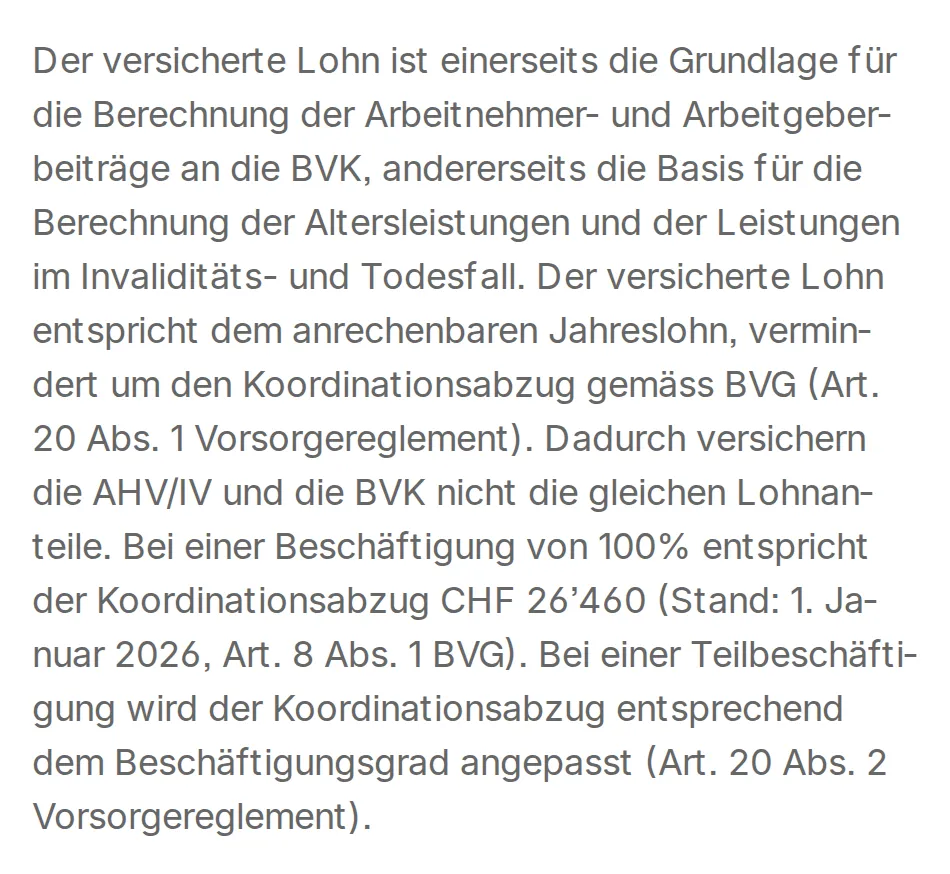
The second pillar, your employer's pension fund, is where 80% hurts. The fund doesn't insure your whole salary. It first takes off a fixed amount called the coordination deduction (Koordinationsabzug), CHF 26,460 in 2026 according to the Federal Social Insurance Office's key figures. Your savings are a share of what's left. If the deduction stays whole while your salary drops, your insured salary falls by more than 20%. The law doesn't require a fund to scale the deduction to your workload: the office's FAQ on part-time work says funds may set a lower deduction or insure the whole salary, but are not obliged to.
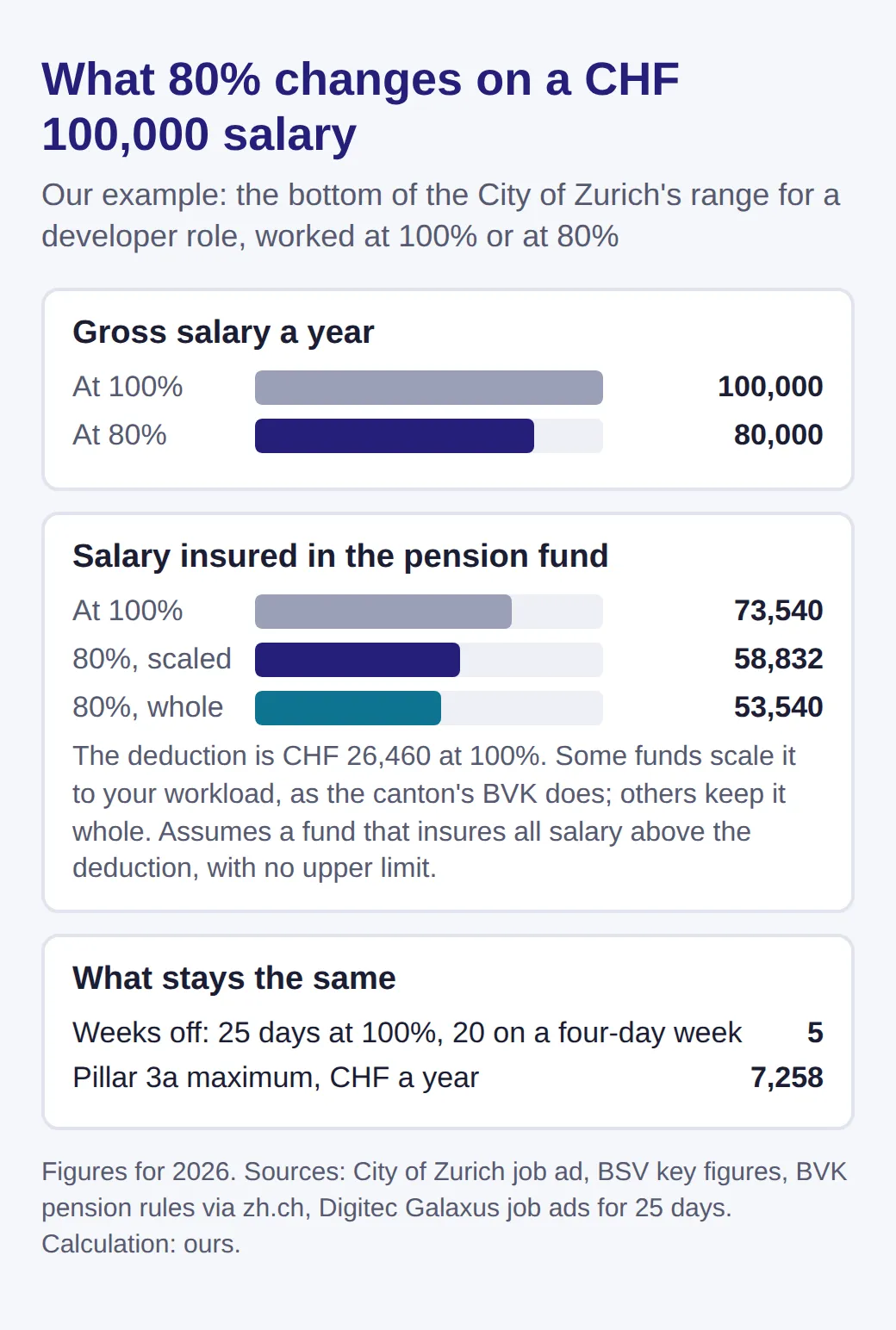
Here is what that means on CHF 100,000, in a fund that insures all of your salary above the deduction, with no upper limit (one that pays only the legal minimum stops at an insured salary of CHF 64,260). At 100%, the fund insures 73,540 (100,000 minus 26,460). At 80%, a fund that scales the deduction insures 58,832, exactly 20% less. A fund that keeps the whole deduction insures 53,540, which is 27% less. The money saved each year follows the insured salary. At the legal minimum rate for ages 35 to 44, 10% of the insured salary, that's CHF 7,354 a year at 100%, 5,883 with the scaled deduction and 5,354 with the whole one. Your fund's own rates may be higher, but the gap works the same way.
The Canton of Zurich is one employer that scales it. Its pension fund, the BVK, sets out the rule on the canton's HR pages:
Before you sign, ask for the fund's rules (Vorsorgereglement) and search them for the coordination deduction and the word Beschäftigungsgrad, the employment level. If the deduction stays whole, you can close part of the gap later with voluntary payments into the fund, called buy-ins, which the law allows up to the benefits the fund's rules provide.
The third pillar doesn't shrink at all. As long as you're in a pension fund, you can pay up to CHF 7,258 a year into a tax-deductible pillar 3a account in 2026, the same at 80% as at 100%. Paying in what the second pillar no longer saves for you is the simplest way to keep your retirement on track.
Before you sign an 80% contract
When the offer arrives, check that the contract states five things: the workload in percent, the days you work, the salary at 100% and at 80%, your holiday in days for your workload, and how overtime is handled. If one is missing, ask for it before you sign, since each is harder to change later.
Then do the pension sum yourself. Find the coordination deduction in the fund's rules, take it off your salary at 80%, whole or scaled as the rules say, and compare the result with your insured salary at 100%. If the gap is wider than 20%, pillar 3a payments or a later buy-in can close part of it. That's an hour of reading against a gap that grows every year you work four days.
Common questions
- Is an 80% job counted as full time or part time?
- It depends who is counting. The Federal Statistical Office counts anyone below 90% as part time, so an 80% job is part time in the national figures. Employers often file an 80–100% role as a full-time job: on our board, 40 of the listings with such a range were marked full time. What matters for you is the percentage written in your contract.
- Am I still insured against accidents outside work at 80%?
- Yes. Part-time employees who work at least eight hours a week for one employer are also insured against accidents outside work, under the accident insurance ordinance. An 80% job is far above that line. Below eight hours, only accidents at work and on the way to work are covered.
- Do I still have to join the pension fund at 80%?
- Yes, as long as you earn more than CHF 22,680 a year from that employer, the entry threshold for 2026. Almost any software engineering salary at 80% clears it. What changes is how much of your salary the fund insures, and that depends on its rules.
- Can I go back to 100% later?
- Only if your employer agrees, because the workload is part of your contract and both sides have to sign a change. Some employers write a review date into the agreement, which you can ask for. If going back matters to you, put it in writing before you sign the 80% contract.
More posts
All posts
Do I Need German to Work in Zurich? Software Jobs 2026
Do you need German for a software job in Zurich? We read all 293 listings on our board: 43% ask for German. What decides it, Swiss German, and courses.

Software Engineer Jobs in Zurich: Companies Hiring in 2026
Which companies hire software engineers in Zurich? Our live listings on 17 October 2026: Google, ZKB, AI start-ups, the canton, and how agency ads work.

Software Engineering Internships in Zurich for Summer 2027
Who takes software engineering interns in Zurich for summer 2027, when to apply, what it pays, and the 15-hour and compulsory-internship permit rules.