Employee Stock Options in Switzerland: Tax Rules for 2026

When the bill comes
In Switzerland, employee shares are taxed as salary when you acquire them, options when you exercise or sell them, and RSUs when they turn into shares. Shares you must keep locked are valued about 6% lower for each year of the lock. Once you own the shares, a later gain is normally tax-free.
That is the short version of a federal law in force since 1 January 2013 and of the Federal Tax Administration's Circular 37, which tells tax offices how to apply it. The cantons follow the same rules, so Zurich's cantonal and municipal tax land at the same moment as the federal one. What most guides skip is the money: how much of your equity actually counts as income, what AHV takes on top, and what the canton keeps if you leave before your last tranche vests. This article goes through each instrument, then puts numbers on one engineer's two years in Zurich.
When are employee stock options taxed in Switzerland?
The rule turns on one question: at what moment does the equity become yours without conditions? That is when the benefit counts as salary, and from then on the tax law treats what you hold as private wealth.
The law, article 17b of the Federal Act on Direct Federal Tax, sets two moments. Shares, and options that are free to trade and listed on an exchange, are taxed when you acquire them. Options that are locked or not listed are taxed when you exercise them. Cash plans that only track the share price, such as phantom shares, are taxed when they pay out (article 17c). Circular 37 adds the one instrument the law doesn't name: RSUs (restricted stock units, a promise of shares later) count as an "expectancy" and are taxed when they become shares.
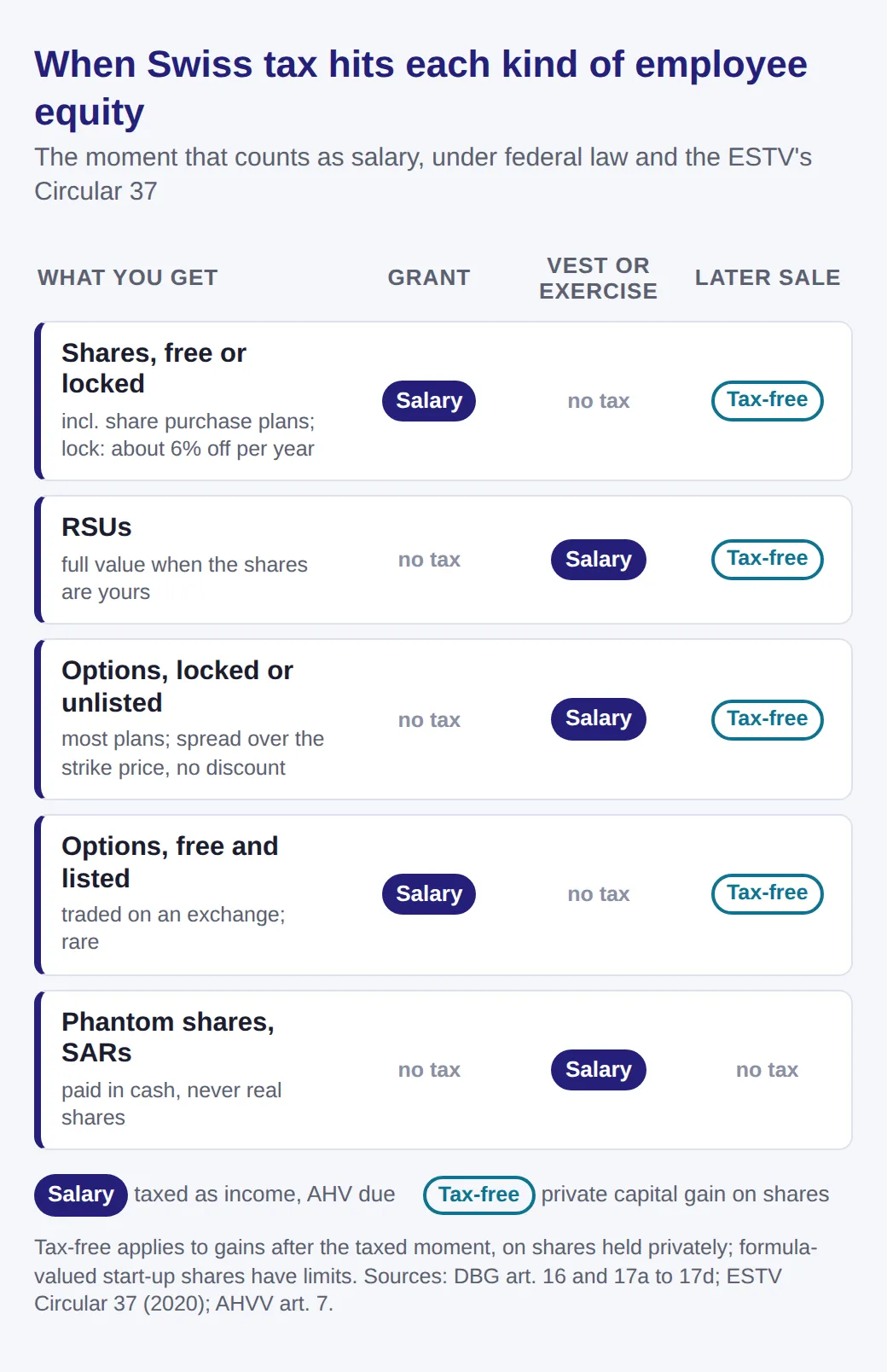
Notice what is missing from the diagram: there is no capital gains tax on shares you hold privately. Article 16 makes gains on private assets tax-free, so the earlier a benefit is taxed, the more of any later rise escapes income tax. That is why the timing matters more than the rate, starting with plain shares.
Shares and purchase plans: taxed when you buy, less for a lock
Shares you receive free or buy at a discount are taxed in the year you acquire them, on the difference between their market value and the price you paid. For listed shares, the market value is the closing price on the day you acquire them, with set rules when a plan gives you a window to accept the offer.
If the plan locks the shares, the law accepts that they are worth less. Article 17b reduces the market value by 6% for each year of the lock, for at most ten years. The circular turns that into a formula, 100 divided by 1.06 to the power of the years left, so the cut grows a little more slowly than 6% a year:
| Locked for | Value taxed |
|---|---|
| 1 year | 94.340% |
| 2 years | 89.000% |
| 3 years | 83.962% |
| 5 years | 74.726% |
| 10 years or more | 55.839% |
Part years count pro rata. Two limits catch people out. A closed window, when insiders may not sell around results, is not a lock under the circular. Neither is a vesting period on RSUs: the discount is for shares you already own but may not sell.
If the lock ends early, for example because the plan releases the shares when you retire, the discount you got is taxed at that point as income. The circular's own example: a share worth CHF 1,500 with 6.46 years of lock left was valued at 68.632%, or CHF 1,029.50, so releasing it early produced CHF 470.50 of taxable income. If you must hand shares back below their value when you leave, you can deduct the loss from your income in that year. RSUs work differently.
RSUs: nothing at grant, full value at vesting
An RSU grant is not taxed, whatever conditions come with it. The Zurich tax office's leaflet on employee equity is explicit: only the moment you acquire the shares counts.
When the units vest and the shares are delivered, their full market value that day is salary. There is no lock discount unless the shares you receive are themselves locked, and there is no money attached: if 50 shares worth CHF 20,000 vest in March, you owe income tax and contributions on CHF 20,000 even if you keep every share. A share price quoted in dollars is converted into francs at the rate of that day.
From the day of delivery, you hold ordinary shares. Sell them a year later for more and the difference is a private capital gain, tax-free. Sell them for less and the loss doesn't count. Options take one step more.
Options: taxed when you exercise, on the spread
Most employee options are locked for a time or not traded on an exchange, and those are taxed when you exercise or sell them. The taxable amount is the value of the share at exercise minus the exercise price you pay, usually called the spread. The whole spread is income: unlike shares, options get no 6% discount for the years you had to wait.
The rare exception is an option that is free to trade and listed on an exchange. That one is taxed when you receive it, on its market value minus any price you pay, and you won't meet it often in an offer letter.
Start-up options and the formula value
A start-up has no share price, so the tax office uses a formula value, worked out by a method that suits the company and must then stay the same for the whole plan. Zurich's leaflet sets the floor at the company's net asset value per share, and never below the shares' nominal value. A valuation done once a year only counts for shares issued within six months of the valuation date, and a real price from a sale of shares within six months before or after the issue normally replaces the formula.
The circular explains why companies push for a formula value: in its example, ten free shares worth CHF 10,000 each after an investor round would give an employee on a modest salary CHF 100,000 of taxable income and no cash to pay the tax. The formula is accepted only if the employer has an unlimited right to buy the shares back at the same formula.
The catch comes at the exit. For shares in an unlisted company valued with a formula, only the rise in that same formula is a tax-free gain. A jump caused by an IPO or a sale to an outside buyer is taxed as income, unless it happens after you have held the shares for five years. And in Zurich, where a formula value was used even though a real price existed, a sale the employer doesn't buy back makes the gain above the formula value income, however long you held the shares. Ask about both before you exercise, and then about contributions.
What AHV takes from your equity
Equity is salary for social insurance too. The AHV ordinance counts benefits from employee equity as earnings and says the timing and the value follow the federal tax rules, so contributions are due at the same moment, on the same amount.
The AHV/IV leaflet on contributions sets old-age, disability and income-compensation contributions at 10.6% for 2026, half from you and half from your employer, so 5.3% comes off your side. These have no upper limit. Unemployment insurance is different: its 2.2%, again split in half, applies only up to CHF 148,200 of pay a year per job, and nothing is due above that.
If your base salary is above that ceiling, equity adds only the 5.3%. On a CHF 160,000 salary, a CHF 20,000 RSU vesting costs you 5.3%, or CHF 1,060, and no unemployment contribution. On a smaller salary, the 1.1% employee share applies to whatever part of the equity still fits under the ceiling. Things get more complicated if you change countries during a vesting period.
Moving to Zurich with unvested equity
If you bring options or RSUs that you started earning abroad, Switzerland taxes only the share earned here. Circular 37 splits the benefit by days: the total, times the days you worked in Switzerland during the vesting period, divided by all the days in that period. Weekends, holidays and sick days are not taken out.
The circular's Annex II has a worked case. An employee granted options on 15 January 2013, with vesting on 1 January 2016, worked in the United Arab Emirates, then Brazil, then from 21 October 2014 in Switzerland, and realised CHF 90,000 in July 2016. Switzerland taxed 437 of 1,081 days, or CHF 36,383, at the tax rate that applies to the full CHF 90,000. Your salary certificate still shows the whole amount; you deduct the foreign part in your tax return as income not taxable in Switzerland.
Shares, and free listed options, that you received before the move can be sold here without Swiss income tax, because Swiss law taxes them at the moment you got them. If you are taxed at source, as foreign residents without a C permit usually are, the equity is added to your pay and taxed at source with it, still only on the Swiss share. Our first 30 days in Zurich covers the rest of that start. Leaving works the same way in reverse, with one Zurich twist.
Leaving Switzerland before your equity vests
When you move abroad and leave your Swiss employer before options or RSUs vest, including a transfer to a group company in another country, Switzerland still taxes the share you earned here, and it collects that tax through your former employer. Article 97a sets the federal part at 11.5% of the Swiss share. The canton adds its own, and for an employer based in the canton of Zurich the total is fixed:
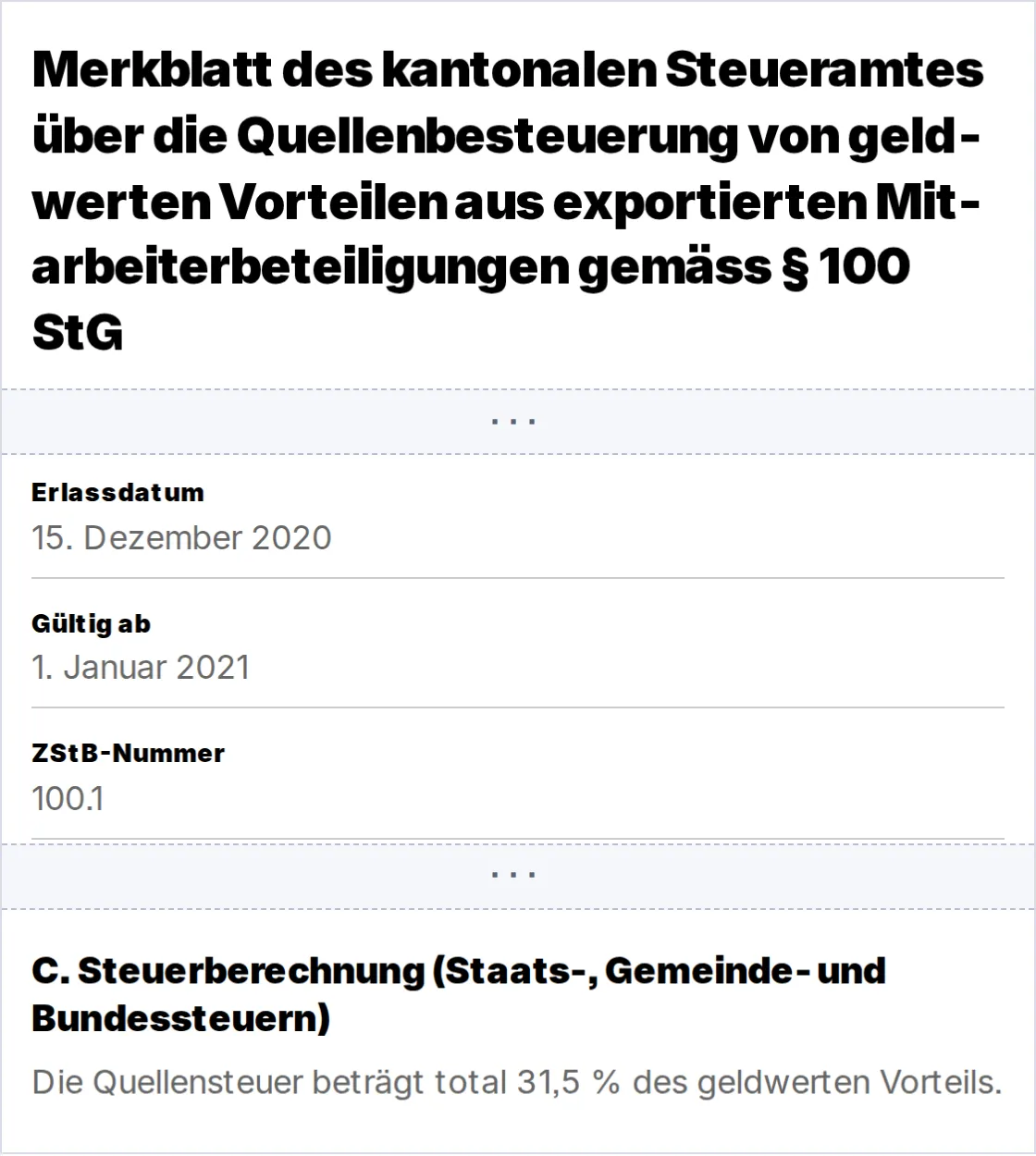
The leaflet covers locked or unlisted options, RSUs and cash plans you were granted or partly earned while living in Switzerland. The employer has to settle the tax within 30 days after the start of the following month and must give you a statement of what it deducted. The duty holds even when the shares come from a foreign parent company, the circular adds. If you disagree with the amount, you can ask the cantonal tax office for a formal decision by the end of March of the following year.
There are exceptions. If you keep working for the same Swiss employer, for example as a cross-border commuter, normal withholding applies instead, and a tax treaty can limit Switzerland's share. Whether your new country taxes the same income again, and credits the Swiss tax, depends on its own rules. Shares you already own, including locked ones, leave with you without any Swiss tax, because they were taxed when you got them. The example below puts all of this together.
A worked example: two years of equity in Zurich
Take an engineer at the Zurich office of a listed company, on CHF 160,000 a year. On 1 March 2026 they are granted 100 RSUs, half vesting after one year and half after two. They also join the company's share purchase plan, and on 1 January 2028 they move to the group's office in another country, employed there by a different group company, and keep their RSUs. The share price is invented; the rules are not.
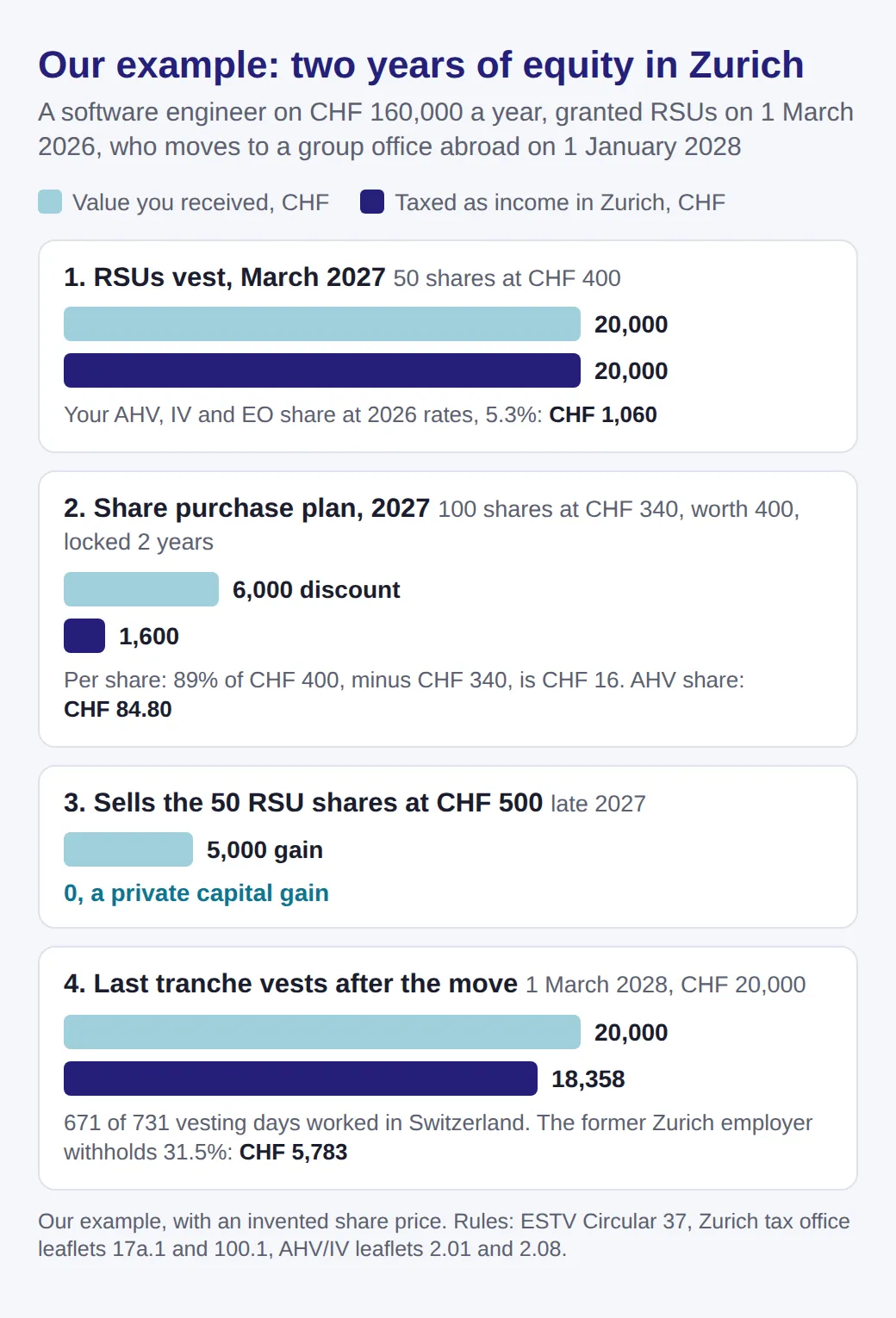
The first tranche vests on 1 March 2027: 50 shares at CHF 400, so CHF 20,000 of salary, all of it earned in Switzerland. At 2026 rates, AHV, IV and EO take CHF 1,060 from the engineer's side, and nothing goes to unemployment insurance because the salary is already above the CHF 148,200 ceiling.
In 2027 the engineer also buys 100 shares through the plan at CHF 340 each, when they trade at CHF 400, locked for two years. Without a lock, the CHF 60 discount per share would be taxed in full, CHF 6,000. With it, each share is valued at 89% of CHF 400, or CHF 356, minus the CHF 340 paid: CHF 16 a share, CHF 1,600 in all. Late in 2027, the 50 RSU shares are sold at CHF 500. The CHF 5,000 rise since vesting is a private capital gain and is not taxed.
The second tranche vests on 1 March 2028, two months after the move. The vesting period ran 731 days, of which 671 were worked in Switzerland, so Switzerland taxes CHF 20,000 times 671 divided by 731: CHF 18,358. The former Swiss employer withholds 31.5% of that, CHF 5,783, of which the federal 11.5% is CHF 2,111. The locked plan shares go along without any further Swiss tax. Social contributions on that last tranche are a separate question, which this example leaves out. One last place where equity shows up is your tax return.
Wealth tax and your tax return
Zurich charges wealth tax on shares you own, at their market or formula value. For locked shares, you can apply the same discount table to the years left, but the leaflet says the tax office won't do it for you: claim it in your return.
RSUs, and options that will be taxed when you exercise them, are not subject to wealth tax, because they are not yours yet. The canton still wants them listed: shares and free listed options go into the securities list at their value, everything else "pro memoria", which means listed without a value. Circular 37 makes you responsible for declaring all of it, even when no income tax is due yet.
Your employer reports the income in box 5 of your salary certificate and attaches a statement that shows how it was worked out. For options and RSUs there are two: one in the year of the grant, one in the year they vest or are exercised. Keep both, together with your plan documents, because the second may arrive years after the first.
Before you accept or exercise
Before you sign an offer with equity in it, ask which instrument it is: shares, options or RSUs, and whether anything is locked. Ask whether the plan has a tax ruling. Zurich lets employers based in the canton have their plan and valuations checked by the tax office in advance, and when one exists, the ruling's authority and date appear on your salary certificate.
At a start-up, ask how the formula value is worked out, whether the company has a buyback right, and what happens to your shares at an IPO within five years. For any plan, set aside cash for the tax in the year shares vest or options are exercised, because the shares are taxed whether you sell them or not. And if you might leave Switzerland within a few years, count the tranches that would vest after you go: with an employer based in Zurich, 31.5% of the Swiss share will be withheld before you see them.
If you are still choosing between employers, start with our guide to who hires software engineers in Zurich.
Common questions
- How are phantom shares and stock appreciation rights taxed?
- They are taxed when the cash is paid to you, and the whole payment counts as salary. Because you never own a share, no part of the payout can be a tax-free capital gain. Until then they are not subject to wealth tax in Zurich.
- My RSUs come from the US parent company. Does my Swiss employer still report them?
- Yes. Circular 37 says the Swiss employer's duty to issue the certificates applies even when the plan is run by a foreign group company or by an outside administrator. The full value goes on your salary certificate in the year the shares are delivered.
- Can I deduct a loss if my shares fall after they vest?
- No. Once you hold the shares privately, a gain on sale is tax-free and a loss simply does not count for income tax. The tax you paid at vesting stays as it was, even if the shares are later worth less.
- Do I owe anything on RSUs I lose when I quit before they vest?
- Granting RSUs triggers no income tax in Zurich, whatever conditions are attached; only the moment you acquire the shares counts. So units that lapse unvested were never taxed and leave nothing to pay. Check your plan to see which units you keep when you leave.
More posts
All posts
Software Engineering Internships in Zurich for Summer 2027
Who takes software engineering interns in Zurich for summer 2027, when to apply, what it pays, and the 15-hour and compulsory-internship permit rules.

Cheapest Health Insurance in Zurich for 2027, Ranked
The lowest 2027 basic health insurance premiums in Zurich, city and region 2, by model, from federal data. Plus the deductible maths and the 30 November rule.

80 Percent Jobs in Zurich: The Four-Day Week in Tech, 2026
How many Zurich software ads allow 80%? We read 287 listings in October 2026. How to ask for four days, and what it does to pay, pension and holidays.